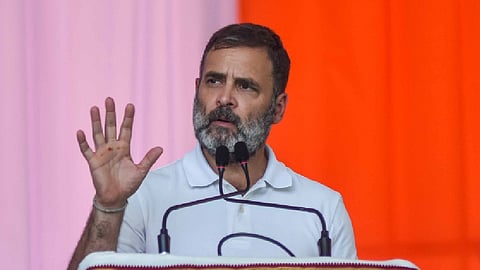

Leader of the Opposition in the Lok Sabha Rahul Gandhi on Tuesday claimed that women associated with the Rashtriya Swayamsevak Sangh (RSS) were supporting his political fight against the organisation, while accusing it of promoting gender inequality.
In a post on X, Gandhi described the RSS as an “all-male, anti-constitutional cult” and contrasted its ideology with his own beliefs, which he linked to “Shiva-Shakti”.
“The RSS is an all-male, anti-constitutional cult that believes women are the property of men. I believe in Shiva-Shakti. That's why it gives me such joy to fight them. What's beautiful is that many of their 'own' women are on my side,” he said.
The remarks mark the latest in a series of attacks by the Congress leader against the RSS.
On October 10, Gandhi accused the Delhi Police of allowing RSS-BJP supporters to attack women protesters and young people amid political tensions over the Special Intensive Revision (SIR) of electoral rolls.
“Amit Shah's Delhi Police has itself descended into thuggery—and it's openly giving license and encouragement to the real goons of RSS-BJP to unleash violence on women and youth,” he had posted on X.
Gandhi has also targeted RSS chief Mohan Bhagwat, describing him as a “villain” in the ongoing political confrontation and urging protesters to continue their demonstrations.
“I’ve been fighting Narendra Modi and the RSS for over a decade now... Narendra Modi, Amit Shah, Mohan Bhagwat, Gyanesh Kumar, and Ajit Doval, the villains of this story, are slowly finding the space closing around them. We are closing that space,” he wrote.
Issuing a direct challenge to the authorities, Gandhi added: “Arrest us all. We are surrounding you, and we are not going to back down. Mark my words: we already have the information we need. We are going to defend our Constitution... Youth of India, I am proud of you. Keep protesting.”
Meanwhile, RSS chief Mohan Bhagwat, addressing the organisation’s annual Vijayadashami gathering in Nagpur on Tuesday, cautioned that protests could become instruments of political interests and deepen social divisions rather than resolve public grievances. He said protests in a democracy should aim to find solutions and urged political leaders, protesters and the administration to respect constitutional limits and norms of civilised public discourse.
