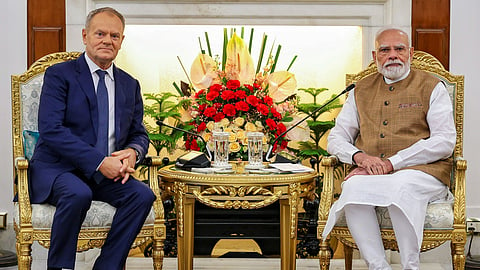

NEW DELHI: India and Poland on Thursday agreed to deepen cooperation in defence, space and nuclear energy, with Prime Minister Narendra Modi and his Polish counterpart Donald Tusk pledging to expand their strategic partnership amid growing global uncertainty and conflicts in Ukraine and West Asia.
Following the bilateral talks, Modi said the two countries would encourage greater industrial collaboration and invite Polish companies to participate in joint development and production across strategic sectors.
“Today we have agreed to deepen ties in defence, space, and nuclear energy. We invite Polish companies to engage in co-development and co-production with India in all these strategic areas,” Modi said in his media statement.
He added that the two sides would explore new partnerships in critical minerals and coal gasification, drawing on Polish expertise. The leaders also discussed economic cooperation, investment and efforts to strengthen supply chains, with Modi expressing confidence that bilateral trade would double by 2030. “The world is going through a period of uncertainty and change. Even at this time, both India and Poland are emerging as important centres of growth, technology, and innovation,” the prime minister said.
Modi said the growing economic strength of the two countries had created fresh opportunities for cooperation, further expanded by the India-European Union free trade agreement. Once the agreement enters into force, it would open new opportunities for Indian exports of machinery, chemicals, plastics and engineering goods to Poland, he said. India would also seek Polish investment in railways and mobility, advanced manufacturing, food processing and biotechnology.
The two countries, he added, would work towards developing trusted global supply chains. The two leaders also reiterated their commitment to democratic values and the rule of law. Modi said India would continue supporting meaningful efforts to restore peace in Ukraine and West Asia, as Tusk’s three-day visit comes amid renewed international efforts to end the war in Ukraine.
Modi also highlighted the historical relationship between the two countries, describing it as a friendship rooted in shared humanitarian values rather than diplomatic engagement alone.
“The friendship between India and Poland is based not merely on diplomatic relations, but on a shared heritage of humanity and compassion,” he said. Modi recalled how the erstwhile royal families of Jamnagar and Kolhapur sheltered thousands of Polish children and families displaced during the Second World War. Maharaja Jam Saheb Digvijaysinhji of Nawanagar, in particular, remains deeply respected in Poland, where he is remembered as the “Good Maharaja”.
“Even today, the people of Poland remember Jam Saheb with great respect as ‘Dobry Maharaja’ -- the ‘Good Maharaja’,” Modi said. Tusk, in his remarks, said the Good Maharaja remained firmly embedded in Poland’s national memory, not merely as a symbol but because of the practical assistance he provided to displaced families. “He remained in our hearts, in our memories, in the national memory, not only as a symbol, because it is not about symbols only. We are talking about a very practical assistance that required a lot of devotion,” Tusk said.
