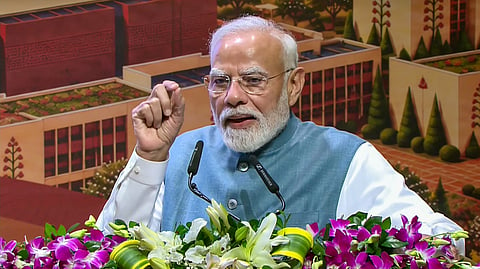

BHUBANESWAR: Prime Minister Narendra Modi on Sunday launched a scathing attack on the Congress saying, before 2014, a different kind of phone banking system was operating in the country, which was available only to a handful of people, either from the party or well connected with the powerful.
Inaugurating the Reserve Bank of India (RBI) Data Centre and Cybersecurity Training Institute at Infovalley-II in Jatni, Modi said, bank loans worth thousands of crores of rupees were given through phone banking to certain Congress leaders and people with whom they had connections. “The poor and middle class families needed a guarantor to open a bank account. But in the phone banking scheme of the Congress, thousands of crores of rupees were available for the rich at any time. As a result of this mismanagement, India’s banking system was hit by NPAs. The banking system was on the verge of collapse,” he said.
He said banks were nationalised in the 1960s and 1970s in the name of helping the poor. Yet, until 2014, more than half of the country’s population remained outside the banking ecosystem. Products such as bank loans were a distant dream even for the middle class. Poor people, small farmers and landless women could not even imagine accessing them, he said.
Referring to former prime minister Rajiv Gandhi’s observation that only 15 paise of every rupee sent from Delhi reached beneficiaries, Modi said direct benefit transfers had enabled the intended amounts to reach beneficiaries directly.
More than 59 crore Jan Dhan accounts have enabled direct transfers of government benefits to beneficiaries, eliminating leakages in welfare delivery. Schemes such as MUDRA, PM SVANidhi and PM Vishwakarma have extended formal credit to small entrepreneurs, street vendors and traditional artisans. Today, digital banking in India has connected everyone with 24-hour banking services, he said.
“The NDA government has adopted a model of pro-people, proactive and good governance. For us, development means balanced development of India, ensuring that villages and smaller cities also have the opportunities. Our goal is to provide better connectivity to remote areas and ensure that poor families have access to facilities which allow them to live with dignity. Our sincere and constant efforts reassure every citizen that they will not be left behind in the journey of development,” Modi said.
The prime minister said in the recent years, the systems India has established and the new ecosystem developed through Digital India have taken banking services to every citizen of the country. “India’s banking sector has become one of the strongest in the world,” he added. The PM said with the blessings of Mahaprabhu, Bhubaneswar is now giving a new institution to New India. He described the RBI Data Centre and Cybersecurity Training Institute as a major step towards strengthening the country’s financial infrastructure and bolstering its defences against rising cyber threats.
He said India’s growing economic strength made it imperative to protect its financial infrastructure from cybercriminals and cyber terrorists. “Today, wars are not fought with weapons. A country can be weakened by attacking its economy,” Modi said and added that modern infrastructure and skilled human resources are essential to tackle the changing nature of cyber threats.
The PM said the RBI’s new facilities reflected the government’s focus on making banking more efficient, reliable and accessible in the coming decades. “The past decade was devoted to taking banking to people who were deprived of it. The coming decade will be about making banking more efficient, reliable and secure,” he said.
The prime minister also emphasised that Odisha is becoming a growth engine for a developed India. The state is expanding beyond its traditional strength in mineral-based industries and building a new ecosystem in semiconductors, electronics, data centres and advanced computing.
“Odisha is going to write a new future, from mines to microchips,” he said, adding that emerging investments in technology and computing will create opportunities for the state’s youth.
Union Finance minister Niramala Sitharaman, Governor Braj Mohan Ram, Chief Minister Mohan Charan Majhi, Union minister Jual Oram, deputy chief ministers Pravati Parida and KV Singh Deo and RBI governor Sanjay Malhotra were present.
