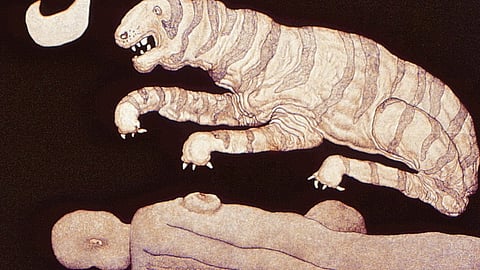

KOLKATA: Some artists paint what they see. Jogen Chowdhury saw what lay beneath the surface.
In the artist’s world, the human body is rarely depicted as perfect; rather it is often portrayed as twisted, fleshy and even grotesque. However, within these forms are tenderness, desire, anxiety and the burdens of being human. A few lines can convey what words fail to express.
With the passing away of master painter Jogen Chowdhury at the age of 87, Indian art has lost one of its greatest modern masters. His visual language was unique and his imagination created images of the human figure that were very strange but very moving.
The line is Jogen Chowdhury’s signature. It is sinuous, complex and cross-hatched to the extreme, defining not only the body but also giving it texture and even life. His use of black is almost sculptural, creating the form of his figures and at the same time drawing the viewer into their world.
The humor in his work sometimes was satirical; sensuality was almost always accompanied by uneasiness. What was most interesting to Chowdhury was human nature in all its imperfections. He found beauty in the awkward, the vulnerable, and the contradictory aspects of humanity.
Jogen Chowdhury was born in Faridpur, undivided Bengal in 1939. His mother used to practice alpona, the traditional Bengal art form of floor decorations. He studied at Government College of Art and Craft in Calcutta and later went to Paris in 1965 on a French government scholarship. Chowdhury was influenced by the different visual traditions of Bengal and other countries but he created a style of his own which was deeply rooted in Indian culture but was also modern.
Chowdhury’s images are more than mere representations of the human form; they are images of the human being in all its complexity, with all its strengths and weaknesses, shaped by the many forces of life. Even when the images deal with the external world and its problems, they never arrive at a simple conclusion. Instead, they present the viewer with the human being in all its complexity, to be looked at again and again.
Chowdhury made the ordinary extraordinary, the imperfect compelling, and the line on paper a tool of extraordinary insight into the human psyche.
West Bengal Chief Minister Suvendu Adhikari said, “We have lost a great artist. His unique style of painting was a great contribution to modern Indian art. Mamata Banerjee, former chief minister of West Bengal, said, “Chowdhury’s work is a great pride for Bengal and for the country.”
Chowdhury was also teaching at Kala Bhavana in Santiniketan for many years. His life was full of activities. He was a member of Rajya Sabha for some time. But his art was his life’s work.
Despite the fame and honors that came his way, the artist remained first and foremost a creator of figures that continued to draw the gaze of the viewer, vulnerable, restless, sometimes disturbing but always alive.
The world that Jogen Chowdhury created will continue to speak to us through his lines long after he has put down his brush.
