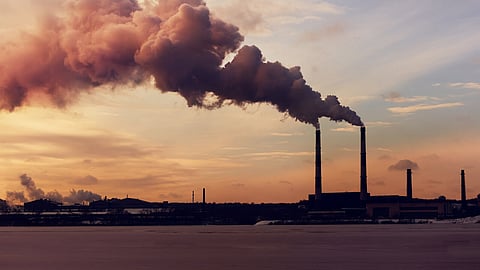

NEW DELHI: A new report by the World Meteorological Organization (WMO), a UN agency, indicates that levels of carbon dioxide (CO2) and other major greenhouse gases (GHG) in the atmosphere reached unprecedented highs in 2025, potentially further warming the planet and leading to more extreme climate events. The report emphasises two other gases that often go unnoticed by policymakers: molecular hydrogen (H2) and sulphur hexafluoride (SF6).
In 2025, the globally averaged surface concentration of CO2 was reported at 426.8 parts per million (ppm), which is 153% of the pre-industrial baseline recorded in 1750. In comparison, the CO2 concentration in 2004 was 377.5 ppm, the report said. Concentrations of methane and nitrous oxide—the second and third most significant long-lived greenhouse gases caused by human activities—also reached record highs.
About half of the total CO2 emitted each year remains in the atmosphere, while the rest is absorbed by the earth’s land ecosystems and oceans. According to the National Oceanic and Atmospheric Administration (NOAA), from 1990 to 2025, long-lived greenhouse gases increased by 56%, with CO2 accounting for approximately 81% of this increase.
The growth rates of CO2 have tripled since the 1960s, escalating from an annual average increase of 0.8 ppm per year to 2.4 ppm per year in the decade from 2011 to 2020. The global average concentration of CO2 rose by 2.8 ppm from 2024 to 2025—above the decadal average but slightly less than the exceptional surge seen from 2023 to 2024.
Methane contributes about 16% of the warming effect caused by long-lived greenhouse gases, yet it has a much shorter atmospheric lifetime than CO2. Approximately 35% of methane emissions come from natural sources, such as wetlands.
In 2025, the globally averaged methane concentration reached 1,948 parts per billion (ppb), or 267% of the 1750 level. Nitrous oxide, the third most significant long-lived greenhouse gas, arises from natural sources and anthropogenic activities such as industrial processes. The globally averaged concentration of nitrous oxide reached 339.1 ppb in 2025, which is 126% above the 1750 level.
Carbon dioxide emission tripled since 1960s: Report
From 1990 to 2025, long-lived greenhouse gases increased by 56%, with CO2 accounting for approximately 81% of this increase, the WMO report said. The growth rates of CO2 have tripled since the 1960s, escalating from an annual average increase of 0.8 ppm per year to 2.4 ppm per year in the decade from 2011 to 2020.
