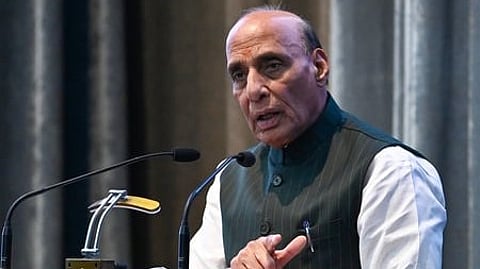

NEW DELHI: Holding up Operation Sindoor as proof of a doctrine tempered in combat and "not classrooms", Defence Minister Rajnath Singh on Thursday offered to share India's counter-terror expertise with Asean and its dialogue partners.
"India's extensive expertise in counter-terrorism is not theoretical classroom knowledge, it is an experience hard-earned through decades of directly confronting complex cross-border security challenges," Singh told the 13th Asean Defence Ministers' Meeting-Plus (ADMM-Plus) in Cebu.
Every Indian strategy, he said, had been tested and refined in actual operations. This was demonstrated during Op Sindoor, when India dismantled terror infrastructure and enforced a non-negotiable red line against state-sponsored terrorism. India was ready to share this experience through joint exercises, capacity-building programmes and intelligence-sharing, the defence ministry quoted him as saying.
The operation also marked the first combat use of the BrahMos supersonic cruise missile, with Sukhoi-30MKI fighters armed with it striking Pakistani airbases. Defence secretary Rajesh Kumar Singh has cited its use in Op Sindoor as a demonstration of the missile's operational capability.
The same supersonic cruise missile, in turn, has emerged as India's flagship defence export in Southeast Asia. The Philippines led the way with a $375 million deal for three shore-based anti-ship missile batteries in January 2022 and has already received systems worth around $330 million.
Vietnam followed, with the defence secretary confirming the deal at the Shangri-La Dialogue in May. Earlier this month, said that India now has contracts or agreements with the Philippines, Vietnam and Indonesia, which together could push BrahMos exports beyond $600 million.
Incidentally, all three nations have stakes in the South China Sea, with the Philippines locked in one of the region's most active territorial disputes with an increasingly assertive China.
Steering clear of naming China, Singh also pressed for adherence to the United Nations Convention on the Law of the Sea (UNCLOS) and freedom of navigation and overflight. He said the push was "not directed against any country" but aimed at safeguarding the collective interests of all nations dependent on open sea lanes.
Notably, Chinese defence minister Dong Jun, who had attended the last two ADMM-Plus meetings, stayed away from Cebu this time, with Beijing deputing its Manila-based defence attaché instead.
Singh, on his part, held bilateral talks with his Philippine, US, Japanese, South Korean and Australian counterparts on the sidelines on Wednesday. His meeting with Philippine national defence secretary Gilberto Teodoro Jr focused on maritime security and joint defence production.
He also drew on the Navy's operational record to back India's maritime credentials and pitched India as a “reliable net security provider in the Indian Ocean Region and the wider Indo-Pacific.”
The Navy has also stepped up its presence in Southeast Asian waters. Stealth frigate INS Sahyadri and missile corvette INS Kulish took part in an ADMM-Plus maritime security drill at Subic Bay, which faces the South China Sea, last month.
The two warships then joined Philippine and Singaporean vessels for the second Asean-India Maritime Exercise (AIME), held earlier this month off the Philippines' Zambales coast.
Moreover, Singh also proposed a dedicated defence 'Youth Bridge' to boost people-to-people connectivity, digital innovation and capacity building between India and Asean.
The ADMM-Plus brings together Asean's 11 member states and eight dialogue partners which include the US, China, Russia, Japan, South Korea, Australia, New Zealand and India.
