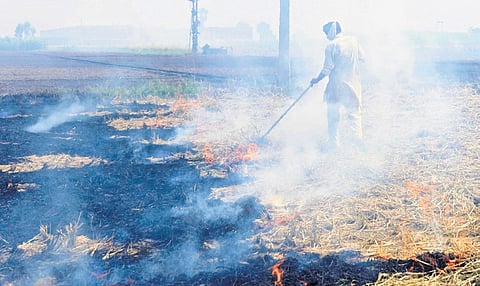

CHANDIGARH: With paddy sown across around 30 lakh hectares in Punjab this year, the state is expected to generate about 18.81 million tonnes of paddy straw. The state recorded a 53 per cent decline in stubble-burning incidents during the 2025 Kharif season, with 5,114 cases reported. Building on the decline, the Punjab government has decided to launch a multi-level information and awareness campaign to further curb paddy straw burning.
Chairing a meeting on the Paddy Straw Management Strategy, Punjab Chief Minister Bhagwant Singh Mann today called for a multi-level information and awareness campaign to further check paddy straw burning in the state, as Punjab’s sustained government-led efforts have already delivered an 86 per cent decline in such incidents from 2023 to 2025.
Directing officers to take the campaign deep into villages and blocks, Mann stressed that active participation of NGOs, social workers, Panchayats and farmers, backed by large-scale social media outreach and stronger ex-situ and in-situ paddy straw management, is essential to consolidate these gains and protect Punjab’s environment.
He stated that around 30 lakh hectares of paddy has been sown in Punjab this year, which is expected to generate 18.81 million tonnes of paddy straw. “Due to the strenuous efforts of the Punjab government, Punjab has witnessed an 86% reduction in stubble fire incidents from 2023 to 2025. The incidents have come down from 36,663 in 2023 to 10,909 in 2024 and further to 5,114 in 2025. We have to take this progress further and ensure that stubble burning incidents are reduced even more this year,” he said.
Calling for an intensified grassroots campaign, he stated, “A massive information and awareness campaign must be launched at the village and block levels to make farmers aware about the hazards of paddy straw burning. Every stakeholder must work together to motivate farmers to adopt sustainable alternatives to stubble burning.”
He said NGOs and social workers should be actively involved in the campaign to strengthen efforts to motivate farmers. “NGOs and social workers should be roped into motivating farmers. Machinery demonstrations, Nukkad Nataqs, meetings with Sarpanches, pledge-taking activities and other awareness programmes must be organised extensively so that the message reaches farmers at the grassroots level,” he said.
Mann also called for a comprehensive digital and multimedia strategy to complement field-level activities. “A detailed digital plan should be implemented covering radio jingles, print media, television, mobile SMS and outdoor media. The social media awareness campaign should also be conducted on a big scale to create wider awareness about the harmful effects of paddy straw burning and the available management options,” he said.
Emphasising the need to encourage farmers and village institutions that perform well, Mann stated, “Progressive farmers, best-performing Panchayats, PACS (Primary Agricultural Credit Societies) and other stakeholders should be felicitated for their contribution. Such recognition will encourage others to adopt better practices and make paddy straw management a collective movement.”
He further stressed the need for close coordination among all stakeholders and districts for effective implementation of the strategy. “Perfect coordination should be ensured among all stakeholders and districts so that the entire plan is implemented smoothly and effectively. Every department and stakeholder must work in a coordinated manner to achieve the desired results,” said Mann.
He also underlined the importance of both ex-situ and in-situ management of paddy straw. “Ex-situ and in-situ management of paddy straw should be encouraged so that farmers can benefit in a big way while the environment is also protected. Our objective should be to provide farmers with practical and sustainable alternatives to stubble burning,” he said.
