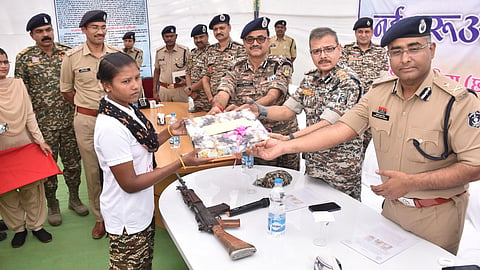

RAIPUR: Surrendering arms in Chhattisgarh will no longer serve as a blanket get-out-of-jail-free card for Maoist insurgents.
According to official figures as many as 2587 Maoists surrendered and 516 cadres were killed in Chhattisgarh between January 2024 and 31 March 2026, the deadline set to wipe-out the left-wing extremism (LWE).
Under its relief and rehabilitation framework for surrendered Maoists, the Chhattisgarh government clarified that renouncing the LWE organisation does not grant automatic immunity or summary termination of pending criminal proceedings.
While the Chhattisgarh Naxalite Surrender/Victim Relief and Rehabilitation Policy, 2025 maps out an institutional pathway back to mainstream society, every case withdrawal remains strictly contingent on rigorous scrutiny, lawful process, and final judicial consent.
Any proposal to withdraw a criminal prosecution must navigate a rigorous, multi-tiered vetting pipeline approved by the state Cabinet in December 2025.
First, at the district level, a designated panel evaluates each surrendered cadre, auditing post-surrender conduct, proof of complete disengagement, and the gravity of their alleged crimes.
Recommendations then pass through Police Headquarters and the Home Department before facing review by a Cabinet Sub-Committee.
For offenses registered under central statutes or where federal jurisdiction applies, mandatory prior approval from the Union Government must be secured.
Even after bureaucratic and ministerial clearance, the executive cannot unilaterally drop charges. The legal mechanism hinges on Section 360 of the Bharatiya Nagarik Suraksha Sanhita (BNSS), 2023—replacing Section 321 of the erstwhile Code of Criminal Procedure (CrPC)—which mandates that the Public Prosecutor formally petition the competent court for consent before withdrawing prosecution.
The court holds sole discretion to sanction or dismiss the withdrawal, evaluating each application against the strict yardsticks of public interest consistent with law and the broader ends of justice. Surrender may open the door to state reintegration, but it does not bypass the law.
By cementing these checks and balances, the state seeks to walk a fine line: offering insurgents a genuine second chance at civilian life without subverting justice for the communities and security personnel who bore the brunt of their violence.
