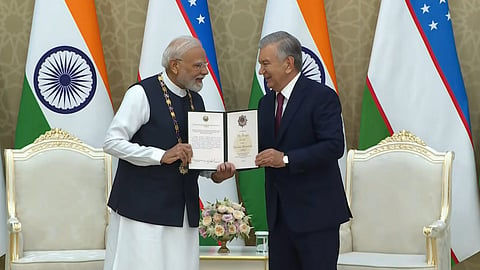

NEW DELHI: Following Prime Minister Narendra Modi’s state visit to Uzbekistan on August 29-30, India has allowed the import of Uzbek chilli and pomegranate, subject to phytosanitary safeguards.
The Ministry of Agriculture and Farmers’ Welfare issued a notification on August 31 permitting imports of fresh chilli and pomegranate from Uzbekistan under a phytosanitary risk-management system.
Under the prescribed conditions, Uzbek fresh chilli must be free from Aculops lycopersici, commonly known as the tomato russet mite, as well as Tomato brown rugose fruit virus. The consignments must also be free of plant debris and soil.
Pomegranate consignments from Uzbekistan must be free of plant debris, weed seeds and soil. They must also be certified as free from Euzophera bigella, or quince moth; Lobesia botrana, also known as the European grapevine moth; Pseudococcus comstocki, or Comstock mealybug; and Botrytis cinerea, commonly known as grey mold.
The move is aimed at strengthening bilateral cooperation in agriculture and food security, while promoting agricultural value chains, export capabilities and trade between India and Uzbekistan.
Uzbek chilli is expected to remain a niche product in the Indian market, while the opening of the market to Uzbek pomegranates could increase competition for domestic producers in major growing states such as Maharashtra, Karnataka, Gujarat and Andhra Pradesh.
India is the world’s largest producer, consumer and exporter of chilli. Around 70 per cent of the country’s chilli production is consumed domestically, while the remaining production is exported. Chilli accounts for around 31 per cent of India’s spice exports.
The import permissions come shortly after Modi’s visit to Uzbekistan, during which the two countries sought to strengthen bilateral economic and agricultural ties.
