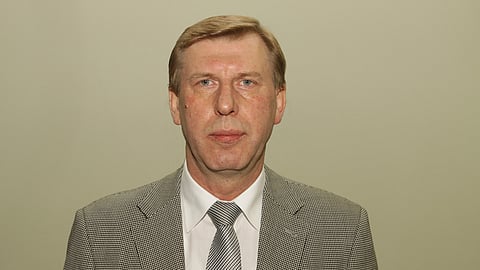

Vladimir Padalko, vice-president of the Chamber of Commerce and Industry of the Russian Federation, is a veteran of international trade and economic diplomacy.
Trained as an economist and fluent in several foreign languages, he is one of Russia’s early business pioneers in China and Hong Kong during the 1990s. Padalko highlighted how BRICS nations can reconstruct their payment system, in conversation with TNIE.
Excerpts:
As financial sanctions and correspondent banking hurdles complicate cross-border payment operations between India and Russia, how can BRICS work to overcome operational challenges?
Since the Russian Federation, for several reasons, has been isolated from other international payment systems, particularly the dollar and the euro, we have asked our partners to work with us and help us make payments in national currencies. With India, however, we have been using local currencies for 100% of all kinds of payments.
Today, over 90% of all transactions in our mutual funds have been adjusted to payments in national currencies. In the current geopolitical situation, we have had some difficulties in collaborating with the global financial system. That’s why we asked our friends, first of all India, to reconstruct the payment system between Russia and India using the Ruble and Rupee.
So, the current situation is that more than 90% of our cross-border payments are made in national currencies, and generally, we have no problems between our countries. Now, we are looking at the possibility of extending the same system to other members of BRICS. We are not against the dollar or euro, but in the current situation, we support trade in local currencies.
Today, within the framework of BRICS, many people are discussing how to work with Russia and build our mutual trade. Everyone is also interested in the stability of their own financial systems. That’s why, as we expect, mutual payments in national currencies will become comparable to payments in other currencies.
Apart from Rupee-Ruble trade, we don’t see any other alternative currency trade. Do you think local currency trade can be successful?
Over time, these local currency settlements will naturally capture a significant share of our total trade volume. We are witnessing a shift as nations prioritise the resilience and autonomy of their cross-border payment networks. That is why we are actively replicating the robust framework originally developed with India across our broader network of international partners.
Ultimately, establishing these independent payment channels will yield clear, long-term strategic and economic advantages that extend far beyond today’s political challenges.
India and Russia are targeting $100 billion in bilateral trade by 2030. India still faces a massive trade deficit exceeding $60 billion due to heavy energy imports. To bridge this gap, what specific Indian goods and sectors is Moscow willing to import?
To address the current trade imbalance between our nations, our immediate priority is to significantly expand imports from India into Russia. We are actively identifying key sectors and specific product categories to drive this expansion. Key industries with vast potential include consumer electronics and pharmaceuticals.
Furthermore, given Russia’s northern geography, we have a strong interest in scaling up agricultural imports.
We are particularly focused on sourcing tropical fruits and fresh produce, such as grapes. In fact, recent discussions with leading commercial partners have focused on substantially boosting grape shipments from India to the Russian market.
We project that these agricultural trade volumes will surpass initial figures, expanding into hundreds of millions of dollars.
Is there any specific challenge that needs to be addressed by Moscow to scale up Indian imports?
The main challenge, we feel, is primarily logistics. We are trying to address that. Both countries also look forward to collaborating in the digital sphere to address these challenges, and we are also looking at IT imports.
