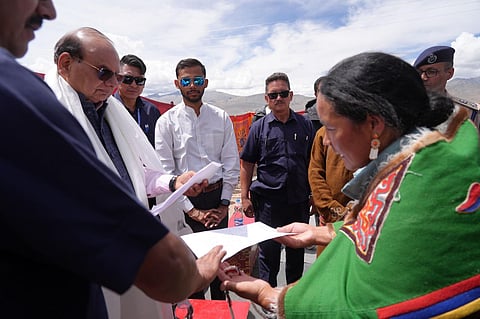

At 15,000 feet in Ladakh, V.K.Saxena has a deceptively simple idea: take water that is disappearing down the mountains and use it to bring a dying lake back.
Water scarcity in Ladakh is a paradox. This is a desert of extraordinary dryness, yet above its barren valleys the glaciers are constantly making water. The problem is not always its absence. Sometimes it is where the water goes.
Delhi’s former Lt. Governor V.K. Saxena, and now of Ladakh is on water campaign by his travels through villages and remote settlements.
“Ladakh is an extremely fragile, high-altitude cold desert, with a unique ecology, that relies almost entirely on glacial meltwater for its agricultural and domestic needs,” he says. “I realized that Ladakh was blessed with abundant water in the form of glacier-melt and snow-melt but the same was not being utilized optimally, that essentially caused the water shortage.”
Villagers told him what they wanted most was not another grand promise of development but water security. The response was a series of relatively simple interventions—Him Sarovar, rock check dams and the channelisation of glacier runoff. The most ambitious of these is now unfolding at Tso Kar, one of Ladakh’s great high-altitude lakes.
Once spread across nearly 11,000 acres, Tso Kar has contracted to roughly 3,200 acres in a decade, a loss of almost 70 per cent. Its retreat has left behind broad, bleached expanses where deep water once stood. With the lake have diminished its migratory birds, including the black-necked crane, and the grazing grounds on which local Pashmina herders depend.

Some herders now travel as far as 75 km from home to find pasture. Saxena visited the lake on August 10. Villagers and the local Nambardar told him what Tso Kar had once been: a vast glacial water body around which communities had traded salt for centuries, while an improbable ecosystem flourished in the cold desert.
He asked the obvious question: where was the water? The answer lay about 11 km away, in the Rupsho Kharnak stream, at an altitude of nearly 18,000 feet.
In summer, the glacier-fed stream can carry as much as 132 cusecs—approximately 320 million litres a day. Much of that water currently flows away into the Sindhu system. Why not send it to Tso Kar?
Fifteen days of surveying followed. On August 30, officials proposed an 11-km RCC channel. Saxena thought better of it. In Ladakh, he argues, an ecological problem should not automatically become a concrete project.
“Unlike Delhi, where administration revolves round urban metropolis characterized by multiplicity of agencies and dual-power politics, governance in Ladakh is more about combating geographical and environmental challenges,” he says.
“Owing to Ladakh’s harsh climate, difficult terrains and very limited working period due to extreme cold, it is crucial that the development works in Ladakh are environmentally sustainable, cost-effective and energy efficient.”
So the mountain itself became part of the engineering plan.Three natural depressions lie along the downward path of the glacier runoff. The largest covers 270 acres, followed by depressions of 24 and 10 acres. Check dams and pipes will regulate the flow between them; sediment will settle along the way. From the third depression, Tso Kar is only 400 metres away. Gravity will do the rest.
No new 11-km concrete canal. No pumps. No energy-hungry machinery. Just water, earth and the contours of the land.The work began on September 2, before winter could close the window for construction.
On September 9, around 20 cusecs of Rupsho Kharnak water began flowing towards the first depression through an earthen channel and a concrete canal that had been lying defunct since 1995. Four days later, roughly a fifth of the first depression had filled. The ingenious part is that the lake is not the only thing being revived. The three depressions will themselves become freshwater wetlands, together capable of holding nearly 1.23 billion litres. They will settle the glacial sediment before releasing cleaner water into Tso Kar, while creating new habitats for migratory birds.
Visible from the Leh-Manali Highway, they may even acquire a second life as landscape and tourist attractions. For Saxena, however, the larger prize is resilience.
“The core idea behind the water conservation and ecological restoration projects is to combat the seasonal water scarcity, strengthen agricultural sustainability and build long-term climate resilience in Ladakh,” he says.
Tso Kar, he believes, can become a “blueprint for ecological restoration in Ladakh’s high altitudes.” There is also a human calculation. Restore the water, and perhaps the grasslands return. Restore the grasslands, and Pashmina goats can graze closer to home. Restore the wetlands, and the cranes may return.
The ecology and the economy, in this landscape, are not separate stories.The experiment follows an earlier Saxena initiative in which about 90 million litres of Stok Glacier water were channelised into Igoo-Phey and Chuchot, bringing irrigation to parched land near Leh.
Tso Kar takes the same philosophy to a grander scale: find water already moving through the landscape and give it somewhere useful to go.
“Success of the Stok Glacier project has proven that large-scale, sustainable water management is entirely feasible in our cold desert, using simple engineering,” Saxena says.
“By redirecting the Rupsho Kharnak stream, we aim at bringing life back into Tso Kar Lake.” It is an unusually modest proposition for an unusually large problem. The project does not create water. It does not conquer the terrain. It simply changes the destination of water that was already there.In Ladakh, that may prove to be the more sophisticated form of engineering: not forcing nature to comply, but paying enough attention to discover where it wants to go.