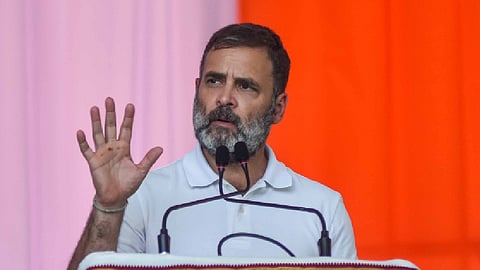

The government on Wednesday questioned Congress leader Rahul Gandhi’s criticism of the decision to levy a Merchant Discount Rate (MDR) on UPI payments above Rs 2,000 made to merchants, citing a recent report of the Parliamentary Standing Committee on Finance that backed a tiered revenue framework for the digital payments system.
According to news agency PTI, a senior government functionary pointed to the committee’s recommendation for a tiered MDR or revenue framework for Unified Payments Interface (UPI), saying the panel had called for it to be notified and operationalised without delay.
The functionary also claimed that five Congress MPs — former finance minister P Chidambaram, Manish Tewari, Gaurav Gogoi, Kishori Lal and K Gopinath — were present when the report was adopted on August 12, and that no dissent was recorded in the published minutes.
“Why is Rahul Gandhi opposing something his own MPs including former finance minister P Chidambaram and former minister in the UPA government Manish Tewari supported within the parliamentary panel,” the functionary said, according to PTI.
Gandhi has criticised the government's decision to impose the fee on UPI payments above Rs 2,000 made to merchants, alleging that Prime Minister Narendra Modi had decided to “prostrate” before US President Donald Trump and give a large amount of money to the US.
The Leader of Opposition in the Lok Sabha has also demanded that the decision be withdrawn.
According to PTI, the Parliamentary Standing Committee on Finance, headed by BJP MP Bhartruhari Mahtab, referred to its earlier recommendation for a viable revenue model for UPI. The panel noted that legislative provisions enabling a tiered MDR structure had been brought forward and stressed the need to notify and operationalise the framework.
The committee, however, expressed concern over the gap between the Rs 2,000-crore allocation for supporting the UPI ecosystem and the industry's estimated operational cost of Rs 20,700 crore.
It said statutory provisions now allow for calibrated MDR on high-value transactions, but warned that delays in operationalising the framework could leave payment service providers dependent on inadequate subsidies.
According to the committee, this could affect investments in cybersecurity, fraud prevention and network infrastructure.
On the incentive scheme for promoting RuPay debit cards and low-value BHIM-UPI person-to-merchant transactions, the panel noted that the government had allocated Rs 2,000 crore for 2026-27 to offset ecosystem costs arising from the zero-MDR policy on RuPay and low-value UPI transactions.
The committee said UPI could process up to 150 billion transactions per month and add 600 million new users, while the existing government incentive covered only about 11 per cent of the industry's actual costs and 14 per cent of potential MDR collections.
It described this as a structural funding gap that could affect long-term investment in digital payment infrastructure.
The panel recommended that, alongside the proposed three-year multi-year scheme and cashback components aimed at expanding digital payments in Tier 3 to Tier 6 cities, the Department of Financial Services should explore a self-reliant, tiered revenue model.
The committee said establishing a viable revenue mechanism was critical to ensuring the financial sustainability of the UPI ecosystem without placing a continuing burden on the government exchequer, PTI reported.
(With inputs from PTI)
