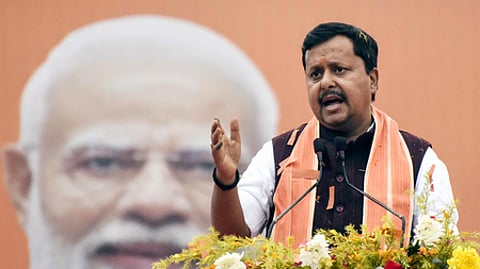

Some old outreach ideas in the BJP Minority Morcha are getting a second innings. Several initiatives conceived during Jamal Siddiqui’s tenure as national president of the Minority Morcha are reportedly being revived, with the organisation looking to reconnect with young people among minorities. Among the programmes are Modi-Mitra, Kalam-Ko-Salam and Saugate-Modi. According to party sources, the initiatives attracted considerable participation from minority communities. A senior functionary said BJP national president Nitin Nabin has asked the newly appointed Minority Morcha chief to revive the programmes. Under Saugate-Modi, kits containing edible items were distributed among economically weaker people from minority communities. The Modi-Mitra initiative reportedly created more than 55,000 Modi mitras in 65 minority-dominated Lok Sabha seats. Whether the old initiatives regain their earlier momentum remains to be seen. For now, the BJP appears ready to dust off its outreach playbook and take it back to the grassroots.
Who will wear the Bengal DGP hat?
The race for West Bengal’s next DGP is gathering pace. With incumbent DGP Siddh Nath Gupta set retire on October 31, the state government is getting the succession process underway. Six senior IPS officers have been shortlisted, with their names sent to UPSC, which will prepare a three-member panel for CM Shubhendu Adhikari to choose the next police chief. The list includes 1991-batch officers Natrajan Ramesh Babu and Anuj Sharma, along with 1993-batch officers Peeyush Pandey, BSF director general Praveen Kumar, Gyanwant Singh and Ajoy Kumar. The corridors of Writers’ Building and the police establishment are keeping an eye on the contenders. Babu, who heads the CID, is being discussed as a frontrunner. Praveen Kumar is in the picture too. His candidature could depend on if he decides to return from Delhi. For now, the DGP chair remains vacant only in the imagination. The real race is just beginning.
Toll plaza’s next digital trick
FASTag may have made toll plazas considerably less cumbersome, but one old problem continues to drive along India’s highways: overloaded trucks. Despite measures introduced by the Ministry of Road Transport and Highways, heavy vehicles carrying loads beyond the permitted limit can still escape the appropriate penalties. Now, with the government looking to introduce barrier-free toll collection across the national highway network within the next six months, the ministry is turning to the private sector for a technological fix. Minister Nitin Gadkari has called on technology companies to develop a system capable of weighing trucks electronically, identifying excess loads and calculating the additional toll payable under prescribed rules. The toll plaza of the future may not need a barrier or even much human intervention, but it will still know what a truck is carrying. The idea is to make technology do the checking, calculating and, presumably, the reminding that an overloaded truck cannot simply breeze through.
A house for the NIA chief
The National Investigation Agency (NIA) chief is set to get something many top bureaucrats would certainly appreciate: an official address in the leafy lanes of Lutyens’ Delhi. The incumbent NIA chief already has a residence in the area, but the government is now looking to designate a house specifically for the post. In other words, the residence will belong to the office, not the occupant, and will remain attached to the NIA chief’s post for future incumbents. A search for a suitable property is currently underway. Among the options reportedly being considered is a house in the vicinity of Home Minister Amit Shah’s residence. For Delhi’s babu-watchers, the move is being viewed as more than just an administrative arrangement. An official residence in Lutyens’ Delhi comes with its own unmistakable cachet—and, in bureaucratic circles, is hardly the sort of perk that goes unnoticed. So, while the NIA chief may change with time, the address could soon remain a permanent fixture on the Delhi power map.
