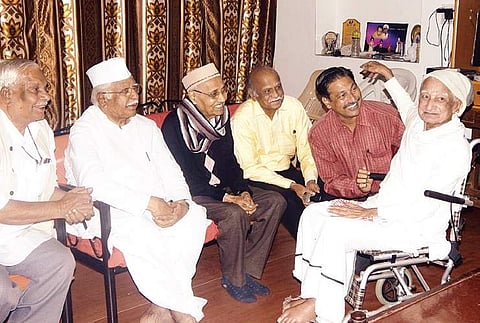

ENAGI, BELAGAVI:Enagi Balappa, a versatile artiste who towered over Karnataka’s theatre scene, died at the ripe old age of 103 on Friday. Hailing from Enagi village of Saundatti taluk in Belagavi, Balappa ajja, as he was fondly known, was ailing for sometime. The veteran actor and theatre company owner was famous for his role as Basavanna and had acted and sung in hundreds of plays and movies.
Born in 1914, Balappa founded the theatre company called ‘Kala Vaibhava’ in 1947 and became popular for his role as Basavanna in ‘Jagajyoti Basaveshwara’. His other plays include Kittur Chennamma, Mavabandnappo Mava, Akkamahadevi, Kumkuma, Devaramaga, Shala Mastara, Hemareddi Mallamma, Raja Harischandra and Ramayana. He also donned female roles owing to his fair skin and youthful looks. He acted in a few movies too, including Maadi Madidavaru, Janumada Jodi, Gadibidi Krishna, Ganayogi Panchakshari Gawai and Parikshe.
Balappa’s career in theatre began as a child artiste. His vast experience in theatre culminated in the publication of two books penned by him: ‘Rangasangeeta’ and ‘Uttara Karnatakada Sangeetada Vibhava’. He used his plays as a medium to fight for India’s freedom and also unification of Karnataka. His plays were popular and spread the richness of classical Kannada language. He never compromised on his art but at the same time believed theatre should evolve.
Four years ago, he was rendered paralytic that restricted his movements but not his spirit. He reprised his famous role of Basaveshwara during a farewell performance at Ravindra Kalakshetra in Bengaluru on the occasion of his 100th birthday. Many of Balappa’s nine children and some of his grandchildren have also carried forward Balappa’s theatre legacy.
Balappa won several awards and honours. Karnataka government honoured him with Rajyotsava award in 1973. Honorary doctorates were awarded by Hampi University, Karnatak University and Mysuru University.
The theatre icon will be buried in his village beside the grave of his first wife Savitramma on Saturday at 11am, said family members. Son Subhash Enagi, a theatre personality, recalled that his father never kept money for his own benefit or his family but used to donate it to the poor and to educational institutions.
“Though he did not directly enter the freedom struggle, he supported it through his plays. He motivated and spread the importance of freedom among youth,” said Subhash.
