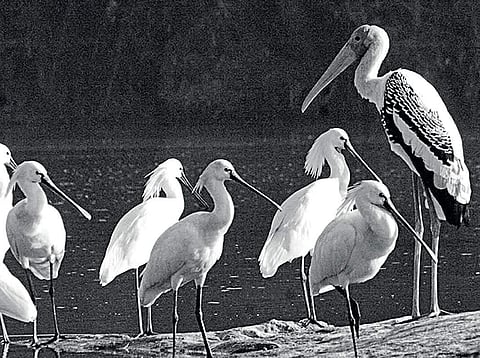

BENGALURU: One of the oldest bird sanctuaries of India, the Ranganathittu Bird Sanctuary — a favourite haunt of both internal and external migratory birds including endangered species — has finally got the Eco-Sensitive Zone (ESZ) protection.As per the Centre’s final notification, a total geographical area of 28.04 sqkm has been declared as ESZ. This prohibits industries and a class of industrial processes and operations that are toxic and hazardous from functioning in its proximity.
This is basically to protect the unique fauna and flora of a group of nine islands in the Cauvery river (a riverine ecosystem) that forms part of the bird sanctuary. The islets are the main breeding and nesting grounds for hundreds of species.With the November 9 notification, 26 villages in Pandavapura, Srirangapatna and T Narsipura taluks, falling within the Eco Sensitive Zone, will have to adhere to central rules and guidelines as far as operations of different industrial and commercial activities are concerned.
Eleven major activities, including setting up of major hydro-electric projects, discharge of effluents, commercial livestock, saw mills and brick kilns among others are prohibited. In fact, all new and existing commercial mining (minor and major minerals), stone quarrying and crushing units are prohibited with immediate effect. No new polluting industries will be allowed within the ESZ henceforth.
No new construction of hotels and resorts will be allowed within 1 km radius of the bird sanctuary’s boundary or up to the extent of the ESZ, whichever is nearer.Any expansion of existing tourist facilities within the ESZ shall be in accordance with the Central guidelines.Situated in Mandya district, the sanctuary has three distinct parts. The first part comprises two islands — the Devaraja Islands in the Cauvery river within Yedatetu village.
The second part comprises three islands within Puttaiah Koppalu village. The third part comprises a cluster of four islands within Gendehosahalli and Arakere villages.The extent and boundary of ESZ varies in the sanctuary’s three distinct parts — it is 0.63 to 1.36 km from the boundary of Devaraja islands, 0.5 to 2.35 km from the boundary of Puttaiah Koppalu islands and 0.35 to 6.0 km from the boundary of the Gendehosahalli islands of the sanctuary.
Supporting a rich avian fauna of 221 species, it includes both resident and migratory birds such as cormorants, darters, egrets, white ibis, spoonbills, herons, open billed and painted storks, Indian river tern, great stone plover and a host of other birds. It is also home to bonnet macaques, otters, palm civet, turtles, marsh crocodiles and numerous fish species.
Welcoming the ESZ protection to the sanctuary, the deputy conservator of forest, Mysuru (Wildlife ) division, Yedukundala said, “With this tag, a host of activities are either prohibited, regulated or promoted and a holistic approach is taken for the sanctuary’s protection. In fact, adjoining areas of the bird sanctuary will get protection so that feeding and nesting grounds of the birds are not affected. If not suitable, birds will not come to this sanctuary. ESZ is necessary for control of uncontrollable development, long term sustainable development and preservation of biodiversity in this protected area.”
