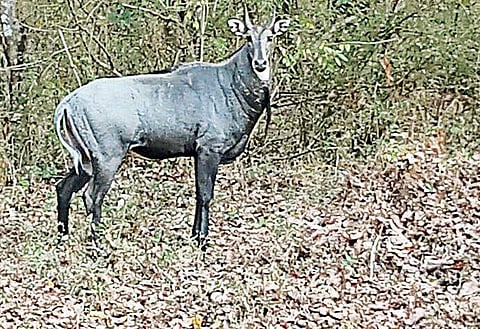

BENGALURU: For the first time in recent years in Karnataka, a Nilgai was sighted in Muthodi Range of Bhadra Tiger Reserve, on Friday evening. To the surprise of the forest staff, the lone, healthy Nilgai, was seen walking on the safari road in the tourism zone of the reserve.The last time that a Nilgai was found in the state was way back in 1952 in Kundakere range (bordering Satyamangalam forests) of Bandipur National Park. The animal, however, was never found again.
Mysuru zoo has a healthy captive population of 70-80 animals which has multiplied over a period of time.
H C Kantharaj, CF, Bhadra Tiger Reserve, told The New Indian Express that it was a big surprise to see the animal in a habitat that is semi-evergreen to moist deciduous. “With Bhadra having a healthy population of tigers and leopards, the animal’s survival here and that too in the open is pretty difficult as it is an easy target for predators. We will observe the animal for another 3-4 days. With this reserve having cameras every 2 sq km and more than 30 anti-poaching camps present, it is surprising that the Nilgai was never sighted. So we suspect that it could have been introduced here,” he said.
According to wildlife activist G Veeresh, a question now arises as to how the animal came to Muthodi which has a habitat totally unsuitable for it. “Nowadays, lots of Nilgai are transported in big trucks from the north to other states for meat consumption. This animal may have been brought to Bababudangiri in the first week of March as part of Urs celebrations. With Muthodi range being very close to Bababudangiri hills, the Nilgai might have escaped to this forest area,” he opines.
However, with the animal found in Muthodi range, it creates doubts over protection work and vigilance at forest check-posts, activists counter. In January last year, a group of hunters were found hunting in Muthodi territorial range and cases were booked against 23 hunters. The department should look into this issue and inquire whether organised gangs dealing with live animals are still operating here. But the CF adds, “After last year’s hunting incident in Tanigebailu Range, the road stays closed from 6 pm to 6 am. In fact, the entire road is blocked now and incidents of hunting have come down. But we will inquire into this issue from other angles.”
Asia’s largest antelope
A scheduled III species and Asia’s largest antelope, Nilgai or blue bull is commonly found in dry regions of Madhyra Pradesh, Bihar, Rajasthan, Assam, Uttar Pradesh, Maharashtra, and in some parts of Andhra Pradesh. But in the south, this species has never been found in wildlife habitat. In fact, in 2016, the Centre had declared this animal as ‘vermin’ for a period of one year in three states. This order was passed by the The Ministry of Environment & Forests on the request of some state governments as the increasing population of Nilgai was destroying crops.
