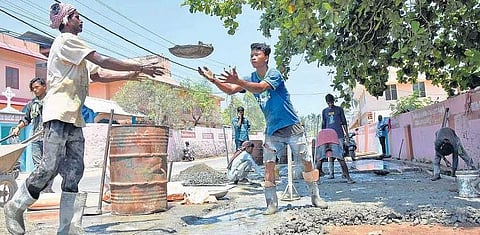

KOCHI: Kerala, which has been on the receiving end of the lower share of the divisible pool of central taxes, can overcome the problem if it plays its cards carefully by allowing the number of migrant workers in the state to be counted as its population in the next census. Experts suggest that encouraging migrant workers to settle in Kerala with their families could lead to their inclusion in the state’s population count. This, in turn, could potentially result in Kerala receiving a larger share from the central government’s divisible pool.
Kerala’s share of the divisible pool of the central taxes has come down from 3.875 per cent in the 10th Finance Commission to 1.925 per cent in the 15th Finance Commission. The main reason for the fall in the divisible pool for Kerala is that more than 60 per cent of the weightage for such devolution is linked to population. Kerala’s population growth is currently below 1 per cent annually, while northern Indian states like Bihar, Madhya Pradesh, Rajasthan, and Uttar Pradesh are growing at close to 2 per cent per year, which contributes to their greater share of the divisible pool.
But counting migrants in the census is often beset with problems, says D Narayana, former director of the Gulati Institute of Finance and Taxation (GIFT) and chairman of the Kerala Public Expenditure Review Committee, who sees immense benefit for the state’s economy if migrants settle down here with their families.
“A conscious effort to offer subsidised accommodation could work wonders, attracting families instead of single males, and expenditure multipliers would come into operation, leading to a win-win situation,” he argues in his recent paper titled Southern India: Parliamentary Representation, Resource Sharing, and Provision of Responsive Public Services post-2026.
A study by Narayana in 2013 estimated the migrant population in Kerala at around 25 lakh. “It would easily be 50–60 lakh now,” he told TNIE. It’s estimated that migrant workers send approximately Rs 20,000-25,000 crore back to their home states annually.
State Planning Board member Dr K Ravi Raman said Kerala has become a ‘welfare magnet’, providing various benefits to migrant workers. Kerala is the first state to enact a social security scheme for migrant workers, and has also been consistently developing welfare policies exclusively for the benefit of the guest workers, he said.
“The state has to feed more people in every sense of the term. You have to provide better accommodation, better healthcare, and even better education. We are very advanced in providing better facilities for their children. The central government has to take these things into account, and these migrant workers should be treated as part of the local population,” he said, pointing out that this can be done without making inclusion in the census a precondition. “I don’t think inclusion in the census should be a precondition to getting more share from the centre,” said Dr Raman.
Maharashtra and Gujarat are the best examples of the trend of migration compensating for low population growth, pointed out Narayana. “Soon the southern states will also be reflecting a similar trend as migration into the south has been accelerating.‘Making the migrants your own people should be the mantra. Don’t treat them as ‘outsiders’. More importantly, get them counted in the census,” he said.
Dr K J Joseph, Director of GIFT, emphasised the potential economic benefits of this strategy. He noted that currently, migrant workers primarily consume items like potatoes that are not subject to GST. “Once they stay here with their families, their spending undergoes a complete shift and includes TVs and washing machines, benefiting the state economy,” he said.