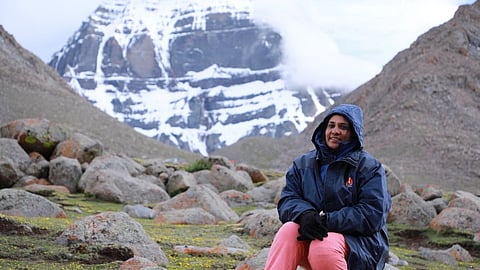

Her name, Mochita Prakrtithi, means the one whose inherent nature is to be free. And so far, her life has proved her name right.
But the discovery took place over the years. It was during her TV anchoring days for Amrita TV’s ‘Udayamritam’ that she came close to realising the essence of her name. The show ran for nearly 13 years, starting in 2004, giving her a distinct identity and something more.
Each of its episodes led her on journeys through her mind, urging her to break the fetters that bound her to the mundane and move beyond to the realm of her true purpose. Such soul-searching paid off as ‘Moskha’—the group that she now manages, helps people on spiritual sojourns.
“I was a student of Women’s College, active in SFI. Journalism was my passion, and I enrolled in a course. My stint with TV journalism began shortly after,” she recalls.
The show kept her bound to a routine—interviews with eminent persons, daily news, etc. “My work required me to move through roads less travelled, unlike the morning shows that were studio-bound and bleak; this was about nature, shrines, and monuments of spiritual legacy. It infused people with positivity to start their day,” she notes.
She worked with her husband Reji Syne who was the brains behind the show. “We had to travel across India, from Kanyakumari to Kashmir, based on a theme ‘Indus Valley Civilisation and Nature’. At first, I was involved in just its scripting, but later started anchoring it too.”

As Mochita worked through each episode, she felt ‘settled’ as though a search was slowly finding its solution. “I was cut off from the world, and the role of nature or ‘prakriti’ was immense in my profession then,” She believes that whenever one rediscovers their link to nature, they become free. “I began discovering the true meaning of my name and purpose then,” she recalls, calling that feeling more rewarding than the umpteen awards she had received over the years.
Mochita was also moved by her interactions with people, “I realised that the most resourceful people were the elders. I absolutely loved speaking to them, documenting what they said because their knowledge would otherwise be lost to posterity,” she notes, adding she considers them her mentors.
Then came her turning point: Kailash yatra in 2012. “By then, we were popular, and I had a sense of accomplishment. I approached the trip as just another assignment. Little did I know the journey would reveal what nature had in store for me. In fact, looking back, I feel everything was nature’s plan in action.”
Yet, the journey was not spurred by any spiritual feeling. “I was more focused on the thought that I wanted to be the first to document Kailash yatra, which no TV channel had done till then,” she explains. But something changed for her the day before they reached Mansarovar. “A silence, deeply enigmatic, shrouded me; it was as tranquil as it was gratifying,” she recalls.
During this time, whenever she slept, she saw a deep blue tint hover around her, filling her senses. Later, on reaching Mansarovar, she understood that it was the lake’s blue tinge that she had felt. “The first sight of Kailash filled me with a strange exhilaration. I threw my hands up and ran towards it, completely losing sense that I was an anchor. I lost consciousness on the banks of Mansarovar, and when I regained it, I felt a changed person—reborn. The experience made me feel I did not need anything more in life.”
Mochita also understood that her purpose now was to share her experiences with true seekers and to help them reach spiritual places like Kailash. “There are people who do not have enough wherewithal to reach there. So, I made a promise that I would help such people,” she says, about her decision to create the travel group called ‘Moksha’. “The travels are not meant for those seeking adventure or on strict schedules. Each place has its energy and legacy, which is the basis of the experience. Spirituality and its awareness are not about temples and rituals; the Indian tradition is to explore its origin in nature, in rivers, in mountains, in the contours of the land, deep in the recesses of the soul of beings….”
The finetuning of Moksha and Mochita’s own purpose happened during the pandemic lockdown, she says. “I consider the lockdown as phase of natural course-correction.”
Moksha now plans trips for other places as well, including Kamakhya, Vrindavan, Kashi, Himalayan retreats and shrines, etc. “We first experience the place ourselves, and then we plan the package, which is usually flexible. We are economical and also offer subsidies based on the traveller’s purpose and intent,” she notes.
Now, Mochita runs yoga sessions too for those interested in signing up for her programmes. “The idea is to declutter life. Some people have experienced a transformation, even those who come to ‘just explore’. It is about letting out the joy trapped inside you — your inner child,” she smiles as she prepares for her 2026 Kailash yatra in August.