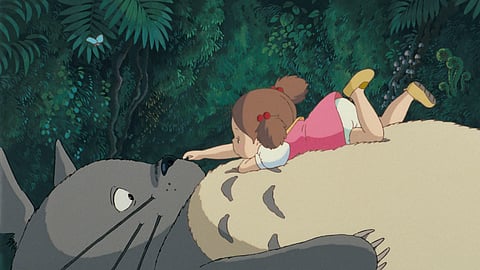

Frames that turn reality into whimsy, characters that fly across the sky, so detailed and filled with warmth and colour that they perfectly blend reality with imagination...
It has been 40 years since Studio Ghibli magic graced the silver screen for the first time.
On August 2, 1986, the wonders of this Japanese animation studio first hit theatres with their film ‘Castle in the Sky’. Directors Hayao Miyazaki and Isao Takahata, along with producer Toshio Suzuki, etched a new chapter in the history of anime, or perhaps art as a whole.
Set up in 1985, the anime revolution of Miyazaki and Co. began with the story of two orphaned teenagers in search of the flying city of Laputa. Drawing from Jonathan Swift’s ‘Gulliver’s Travels’ and the quest literature of Jules Verne and R L Stevenson, the film was not a commercial success upon its release.
The turning point for the filmmakers came in 1988, when they released two of their most revered films, ‘Grave of the Fireflies’ and ‘My Neighbour Totoro’. The former told a heartbreaking story of grief against the backdrop of World War II. And ‘Totoro’, the studio’s most beloved film, eternalised a large and gentle forest spirit. Fans received both films with open arms.
Then came ‘Kiki’s Delivery Service’, giving voice to the worries of young girls leaving home for new towns.
That is the magic of Ghibli. Through picturesque frames and colourful art, they weave tales of ordinary people and their lives. Joe Hisaishi’s baroque and jazz styles music complements the charm of Ghibiliverse.

In the 2001 Oscar-winning film ‘Spirited Away’, Miyazaki unveils the wonders of a magical world where spirits dwell. Through young girl Chihiro and her dragon companion Haku, the animation extravaganza speaks about social issues in a rapidly urbanising world through whimsical characters and settings.
In their fairly simplistic film drew a biopic of renowned Japanese aeronautical engineer Jiro Horikoshi, depicting his struggles and successes against the backdrop of Japan’s pre-war industrial development.
During the 1990s, tie-ups with Walt Disney helped Studio Ghibli productions gain immense popularity, and the films were later dubbed into many languages around the world. References from their films entered pop culture through merchandise, games, and even a personality aesthetic that became popular as “Ghibli-coded”.
By 2023, Studio Ghibli had released 24 feature-length animated films. Summing up the principles behind the films he created, Miyazaki, the honorary chairman of the studio, remarked: “I believe that fantasy in the meaning of imagination is very important. We shouldn’t stick too close to everyday reality but give room to the reality at heart, of the mind and of the imagination.”
And that philosophy is what made college student Aathira Suresh an ardent Ghibli fan. “There is a sense of deep emotional connection,” she says.
“Their films have a quality to instantly lift your mood and give you hope to get out of depressive slumps and move forward with life.”
Ghibli movies, she adds, appeal to both youngsters and adults in various phases of their lives.
“As a school student, I liked the ‘Whisper of the Heart’. It has a character who figures out how to navigate life — in studies and writing. Unlike the usual plot-driven movies, which focus on struggles rewarded by success at the end, Miyazaki gives importance to the feelings of that little girl. This style appealed to me a lot,” she says. “And as I grew up, I started relating more with ‘Kiki’s Delivery Service’.”
The studio’s artistry, with its simplistic strokes and movements, also captures real life without mimicking it. Within a short period of time, these films went on to ignite the imaginations of artists worldwide.
Balaram J, creative director at Eunoians Studio, recalls trying to mimic the quintessential Ghibli style in his youth. “During our student days, animators often tried to create films and comic strips mimicking that very style, even though we presented our personal tastes in professional settings,” he says.
“Their success lies in the honesty of its storytelling. They go beyond the struggles of commercial appeal, bringing in unconventional styles and personal attributes,” he notes.
“In most of their films, they bring in child characters and show us how they respectfully deal with them. They also understood that politics and philosophy equally appeal to both children and adults.”
Echoing the admiration, award-winning animator and Studio Eeksaurus founder Suresh Eriyat terms Studio Ghibli as “a huge personal inspiration”.
“It lit a spark in us to set up our own studio,” he adds. “I also have a personal connection with Studio Ghibli. Back in 2016, I was invited to present our stop-motion animation film ‘Tokri’ at the Ghibli Museum. It was one of the biggest fanboy experiences for me. Last year, I was invited as a jury member at the Tokyo Anime Award Festival and visited Studio Ghibli. During that visit, I also had the unforgettable opportunity to meet Miyazaki.”
The tradition continues. A prime example is the recent film ‘Balan’. Director Chidambaram S Poduval attributed the inspiration behind several scenic frames in the film to his love for Studio Ghibli.
The wonders of Ghibli, clearly, continue to capture the love of generations of fans worldwide. Be it through film frames or just an AI-made social media DP.