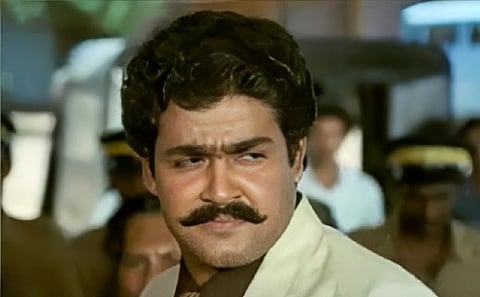

A year with 34 releases could easily have reduced an actor to repetition. For Mohanlal, 1986 did the opposite.
He appeared as a struggling salesman, a harried house owner, a tender lover, a journalist crusader, a psychiatric patient and an underworld don whose name would become inseparable from his rise to superstardom.
With each release, the contours of the actor audiences thought they knew were redrawn. Turning at least 21 of 34 releases into hits was a serious flex.
He played extremes with ease. Sathyan Anthikad’s ‘T P Balagopalan MA’ cast him as a lower middle-class salesman navigating family burdens, small dreams and life’s unexpected turns.
The performance earned Mohanlal his first Kerala State Film Award for Best Actor, making him the youngest recipient at the time.
‘Rajavinte Makan’, meanwhile, gave him the stature and swagger of a major commercial hero, with punches and punchlines thrown to good effect.
Forty years later, 1986 resembles a career in miniature. It defined Mohanlal’s screen presence for decades to come.
The man next door
‘T P Balagopalan MA’ found its drama in a life that rarely receives heroic dimensions: that of a young man surviving on a modest white-collar salary while carrying the demands of his family.
“I would say ‘T P Balagopalan MA’ — my first superhit — marked the beginning of the second chapter of my film career. A fresh new beginning,” says ace filmmaker Sathyan Anthikad, who also received his first State Film Award (Best Story) for the film.
The first thread, he says, was about a poorly paid employee and a woman facing similar struggles, and how ordinary incidents bring their lives together. Mohanlal and Shobana were in his mind from the outset.
“After seeing the magic Mohanlal created in ‘Appunni’, I sought to accommodate him whenever I began thinking about a film,” Sathyan says.
“But when Sreenivasan came in, the colour and texture of the film changed. The issues became more realistic, and humour was used very effectively.”
The film brought Sathyan, Mohanlal, Sreenivasan and cinematographer Vipin Mohan together for the first time, beginning an association that continued across several films.
Sathyan had initially approached Venu Nagavally to write the screenplay, but he was busy. Impressed by Sreenivasan’s situational humour and dialogues in ‘Mutharamkunnu P O’, Sathyan got his address from Nedumudi Venu and sent him a telegram.

“He came to Chennai, liked the thread and we began working. The second half was written in a single night,” Sathyan reveals. “We could never match that record again. Later, we took almost a year to write ‘Nadodikkattu’.”
Sathyan recalls that everyone on the set called Mohanlal ‘Balagopalan’ throughout the shoot.
“I also remember some members of the unit saying that Mohanlal did not seem to be acting,” he smiles.
“I told them that was exactly what I wanted. He was not acting; he was simply behaving, living the character.”
Producer T K Balachandran, who was also interested in acting, appeared as the palm reader who tells Balagopalan, “Ninakku bhagyam varunnundu (good fortune is on its way).”
In hindsight, the line seemed almost prophetic for those behind the film as well.
“I have had bigger hits and films I may like more, but the emotional attachment to this one is different,” says Sathyan. “On the eve of its release, I felt possessive, as though the character was leaving my hands and becoming the audience’s.”
Maniyanpilla Raju, who played Balagopalan’s friend Narayankutty, remembers the warm chemistry he shared with Mohanlal and the precision of Sreenivasan’s script.
“The film was completed in a single Thiruvananthapuram schedule of about 20 to 25 days,” he recalls. “The characters and situations were realistic. Everyone could find something familiar in them.”
The same year also saw two other Sathyan Anthikad–Mohanlal films still enjoyed today — ‘Sanmanassullavarkku Samadhanam’ and ‘Gandhinagar 2nd Street’. Mohanlal was just 26 then.
“Not just in my films — he was playing several complex characters in a single year at that age. That was his magic,” Sathyan says.
Four decades on, Sathyan says the films continue to find viewers at home. Harder to recreate, however, is the rich supporting world that once gave such stories life.
“When I wrote an uncle character, I would immediately think of Sankaradi. For an elder sister, it would be [KPAC] Lalitha chechi. Then there were Oduvil Unnikrishnan, Innocent, Mamukkoya and Thilakan,” he says. “Their absence has left a void.”
The anti-hero takes over
While Balagopalan carried the burdens of ordinary life, Vincent Gomes entered a world of political power, crime and betrayal.
‘Rajavinte Makan’ gave Mohanlal not just an action role, but the stature of a commercial hero whose authority rested as much on speech and stillness as on violence.
Director Thampi Kannanthanam was coming off the failure of ‘Aa Neram Alppa Dooram’ when writer Dennis Joseph approached him with a script inspired by Sidney Sheldon’s novel ‘Rage of Angels’.
Dennis initially conceived Vincent Gomes for Mammootty, who liked the script but eventually declined the film. Mohanlal was then approached on the sets of ‘Kariyilakkattu Pole’, and the screenplay was modified to suit his performance style.
“Kannanthanam’s faith in the project was immense: he sold his car and ancestral property to meet the budget,” recalls an industry insider who prefers not being named.
Actor Ambika, who played advocate Nancy, recalls that Mohanlal himself had wondered whether Kannanthanam wanted to take the risk of casting him in the lead — a conversation the director later recounted to her.
“Look at the film now. Even the new generation would name ‘Rajavinte Makan’ among their favourite Mohanlal films,” she says.
Notably, Ambika received a higher remuneration than Mohanlal for the film.
For her, the film’s enduring place in popular culture is most visible in its dialogues. Lines such as “My phone number is double two double five”,
“Rajumon orikkal ennodu chodichu, uncle-inte father aaraannu? Njan paranju, oru rajaavaanu...”, and “Manassil kuttabodham thonni thudangiyaal pinne cheyyunnathellam yaanthrikamaayirikkum” continue to live on.
“When people still speak about the film, I feel happy and perhaps some beautiful arrogance too,” Ambika says.
She remembers Mohanlal sustaining injuries during the explosive climax in which Vincent arrives with a machine gun.
“Kannanthanam offered to postpone the scene, but Mohanlal chose to complete it because it was the final day of shooting,” she says.
The film was remade in Tamil, Kannada, Telugu and Hindi. Ambika reprised Nancy in the Tamil and Kannada versions. She recalls the lead actors asking after scenes whether they had performed them “like Lalettan”.
“They had studied him like a textbook,” she says.
The number ‘2255’ became such a hit that Mohanlal used it for his car, while Ambika later made it part of her phone number.
“Even now, when someone asks for my number, I give the first few digits and ask them to guess the last four. They immediately ask, ‘Is it 2255?’”
Ambika remembers Kannanthanam waiting anxiously through the first screening.
“When the response became apparent, he wept with relief,” she says, adding that, had he lived longer, he would certainly have planned a sequel.
Actor and star, in parallel
The film also won Mohanlal a strong following among younger audiences, cementing his status as a cult hero.
Film critic A Chandrasekhar notes that his first registered fans’ association formed after ‘Rajavinte Makan’.
Chandrasekhar sees the two films as parallel milestones. “‘T P Balagopalan MA’ established Mohanlal as an actor rooted in recognisable lives, while ‘Rajavinte Makan’ established him as a star capable of carrying a film on his own,” he says.
Chandrasekhar places Sathyan Anthikad’s cinema within the tradition of grounded, light-hearted films associated with Sai Paranjpye and Basu Chatterjee.
“Sathyan’s films gave that sensibility a distinctly Malayali social world. ‘Rajavinte Makan’, on the other hand, was an experiment in scale, making and anti-heroism,” he says.
Film critic Vijayakrishnan says 1986 brought Mohanlal to several filmmakers, each discovering a different possibility in him.
“These two films are perfect examples of two distinct emotional registers. He played several complex characters that year. Mohanlal became almost inevitable in Malayalam cinema,” he says.
“For any industry to grow, different kinds of films must coexist, and 1986 was a perfect example of that. In that sense, 1986 was an important year not just for Mohanlal, but for Malayalam cinema on the whole.”
Mohanlal’s 34 releases of 1986
1. Pappan Priyappetta Pappan
2. Doore Doore Oru Koodu Koottam
3. Mazha Peyyunnu Maddalam Kottunnu
4. Panchagni
5. Abhayam Thedi
6. T. P. Balagopalan M.A
7. Deshadanakkili Karayarilla
8. Vartha
9. Iniyum Kurukshetrum
10. Revathikkoru Pavakkutty
12. Kunjattakkilikal
15. Neram Pularumbol
17. Kaveri
20. Rajavinte Makan
21. Yuvajanotsavam
22. Sukhamo Devi
24. Nimishangal
28. Thalavattam
29. Geetham
32. Padayani
33. Adiverukal
34. Shobhraj