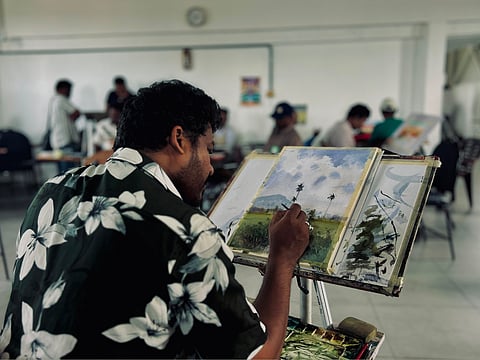

Strains of evergreen Malayalam songs from the 1990s drifted through the hall as brushes swished gently across paper. Over 40 watercolour artists sat immersed in their work, capturing landscapes, memories and everyday moments in delicate washes of colour.
By the end of the day, about 90 paintings had come to life. Not just as works of art, but as a way of giving back.
The recent gathering marked the third edition of ‘Colours of Care’, an initiative by Aquarelle Kerala in collaboration with Raksha Society, a vocational special school in Mattancherry. And the venue was the society’s school.
Proceeds from the paintings will go towards purchasing study materials and vocational essentials for the neurodivergent students of the institution, the organisers say.
Aquarelle Kerala traces its origins to an exhibition titled ‘Aquarelle’, organised by a group of artists who wanted to celebrate watercolour.
Following its success, the late artist Mopasang Valath suggested taking the idea further by creating a collective that would support watercolour artists across the state and encourage budding talents.
The organisation, founded by eight artists, has since grown into a statewide community dedicated to promoting, educating and creating opportunities for watercolour painters.
“Watercolour is as transparent as the artist’s mind. Once you begin working with it, there is no return ticket and your desire for it only grows,” says Sandeep Ramnath, chief coordinator of Aquarelle Kerala.
Unlike acrylic or oil, he says, watercolour demands confidence, precision and an acceptance that every brushstroke is permanent.
Artist and event coordinator Ajeesh Kochi believes that very unpredictability is what makes watercolour so compelling. “The balance between brush, colour, water and the artist has to be just right. That element of risk is what makes it different,” he says.
The collective’s social outreach began almost by chance. While working at Raksha Society, Ajeesh discussed the possibility of collaborating with the institution. The idea gradually evolved into Colours of Care under the guidance of Mopasang, who envisioned an art camp that could both raise funds and create meaningful opportunities for artists.
“It is not about money. It is about how we can help others with the skills we have,” says Ajeesh. “The more exposure we get, the greater the support the students receive.”
For Raksha Society, which works with children and young adults with intellectual disabilities, autism, cerebral palsy and multiple disabilities, the partnership has become much more than a fundraiser.

“The primary aim is fundraising, but beyond that, they are creating a platform for artists while benefiting our students. It has become meaningful for both sides,” says Elizabeth Philip, who oversees the institution.
The collective has also taken its art and purpose beyond Kochi. It has organised camps at Saigramam, a humanitarian heritage village in Thiruvananthapuram, where artists from across India converge and donate paintings created during the event to support the Sai Gramam Global Trust.
Aquarelle Kerala has also collaborated with distinguished watercolour artists such as Milind Mulick and Bijay Biswaal, while continuing to organise camps and exhibitions that bring artists together across the state.
For Shalini B Menon, an executive committee member of Aquarelle Kerala, the medium itself reflects the spirit of the initiative. “Watercolour painting and this camp are mutually enriching. The beauty of watercolour lies in its unpredictability. It is therapeutic, a stress buster, and no other medium can match its precision,” says the artist.
She adds that Raksha camp’s efforts will culminate in a four-day exhibition and sale at David Hall in Fort Kochi once the tourist season begins in October.
“Visitors can take home original watercolour works while contributing to the education and vocational training of Raksha’s students,” says Shalini.
For Aquarelle Kerala, every brushstroke serves a dual purpose: keeping alive the timeless charm of watercolour and demonstrating how art, in its understated way, can become an instrument of care.
This story has been reported by Smriti Saraswati for TNIE-Kerala