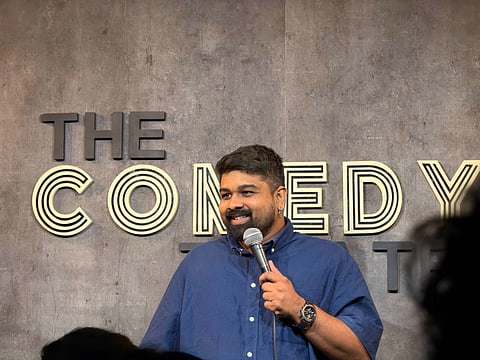

Before audiences knew him as Standup Sabari, Sabareesh Narayanan spent his days working in marketing. He started performing back in 2017, when Malayalam stand-up comedy was still finding its footing. Today, he has officially replaced presentations with punchlines.
His latest special, ‘Kooduthal Chinthikkanda’, is the first Malayalam stand-up comedy special to stream on an OTT platform. In a quick chat with TNIE, Sabari looks back at his journey, his anxieties, and hopes for the future.
What got you into stand-up comedy?
In school, every Friday we used to have a free period for co-curricular activities. We used to stage skits and plays in front of the class as we did not have any other talents like singing or dancing. This was our thing. It was one of the happiest phases of my life.
Then I came across stand-up as a profession, and it felt like something we used to do as kids. I started watching Abish Mathew, Kanan Gill, Naveen Richards, Max Amini and definitely Rowan Atkinson; Mr Bean was something everyone watched at home regardless of age. Well, soon I wanted to be like them.
You have been in the field for almost eight years now. How was the Malayalam stand-up scene when you were starting?
The major problem I faced was that there were no established Malayali stand-up comedians. Malayalis have a different relationship with comedy altogether. We are known for Ottan Thullal, Chakiyar Koothu, mimicry artists and skit performers.
I wanted to improve my skills; that’s when I reached out to Praveen Kumar, the Chennai-based stand-up comedian, on Facebook. He was already famous, and kindly replied to my messages, providing me with a lot of guidance. He did so in person too.
And then I attended as many open mics as possible. There were no open mic events anywhere in Kerala, so I used to take time off from my marketing job and attend open mics in Chennai and Bengaluru.

How has the experience of recording and producing a special been?
Managing the logistics of the recording is already tough. But what is tougher is that I cannot predict how the jokes will land. There have been times when a joke got a stronger reaction when I was performing and not recording. This is a stand-up comedian’s worst nightmare. In such moments, there is not much that we can do. Only hope for the best. Or go home and cry (laughs).
You speak about anxiety and overthinking in the special. How do you draw the line between becoming too personal?
I was sure that I wanted to share real stories; only then would the show be authentic.
I believe that becoming comfortable with being vulnerable on stage is a part of being a stand-up comedy artist.
It is scary as well, because I am not someone who shares my feelings easily. However, it helps me get over my fear and has become like my coping mechanism — almost therapeutic.
What do you do to make sure you don’t become offensive?
There are some liberties that a comedian can and should take.
Something I learnt through studying the history of comedy is that, for example, kings would have court jesters, and only they had the right to make fun of the king.
Comedy was also used in countries like the US to raise awareness and a voice for the rights of black people. Comedians are at times the ones who conduct a reality check, and that comes with a price — they are easy targets. I believe in speaking truth to power. But some boundaries should not be crossed. I believe that good comedy does not come at the cost of the oppressed.
It is easy to make fun of people without power, but it is never funny. Everyone has a sense of right and wrong, and that audit should come from within, especially for comedians.