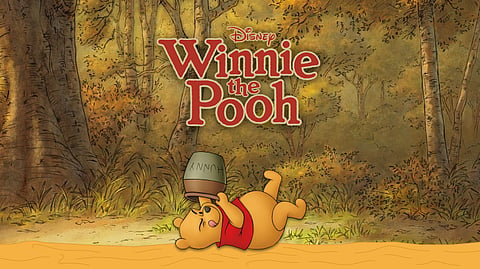

"And the only reason for making honey is so as I can eat it,” reasons Winnie-the-Pooh with himself before climbing a tree in search of honey.
Through this line, A A Milne introduced the delightfully uncomplicated ‘logic’ that has defined the cuddly yellow bear. A century later, Pooh continues to allure readers with this simple, effortless charm.
Milne first published ‘Winnie-the-Pooh’ in 1926, together with E H Shepard’s illustrations. Inspired by the bedtime stories he told his son Christopher Robin, the book transported readers to a new world of the Hundred Acre Wood and its inhabitants — Pooh, Piglet, Eeyore, Rabbit, Owl, Kanga, Roo and Christopher Robin, whom he named after his son.
While Pooh had already appeared in Milne’s poetry collections, the book’s success led him to publish more works featuring the beloved bear, including ‘Now We Are Six’ (1927) and ‘The House at Pooh Corner’ (1928).
Unlike most children’s literature of the time, ‘Winnie-the-Pooh’ had no evil villain to vanquish or kingdom to save. Its adventures were ordinary — searching for honey, getting stuck in Rabbit’s doorway after eating too much, celebrating Eeyore’s birthday, hunting a Woozle or setting out to discover the North Pole.
The events were small, but they explored larger ideas of friendship, kindness, imagination and acceptance, presented simply enough for children to understand yet deep enough for adults to continue discovering new meanings.
Over time, Pooh appeared in comic strips, radio adaptations, television cartoons, Disney animations and feature films, introducing him to generations who may never have read Milne’s original work.

In fact, the familiar red shirt now synonymous with Pooh wasn’t part of Shepard’s original illustrations. It became associated with the character through merchandise in the 1930s and was later popularised by Disney.
Despite these reinventions, readers continue to return to the original stories.
For 72-year-old Philip Abraham, Pooh is forever tied to a childhood memory from the Nilgiris. After caning him one day, his Class 5 teacher handed him a copy of ‘Winnie-the-Pooh’ as consolation.
“I was hooked. The ‘bear of very little brain’ became one of my best friends,” he smiles.
A former bank employee, Philip reminisces about spending hours with Pooh and his companions in the Hundred Acre Wood.
“The dear silly old bear and my teacher are forever linked in my mind,” he chuckles.
What endeared the book to him, he adds, was “Pooh’s kindness and the wonderfully imaginative cast of characters”.
A different journey led 27-year-old marketing consultant Jessica Mascarenhas to Pooh. During a visit to Chennai as a child, she was captivated by a giant Winnie-the-Pooh stuffed toy displayed in a shop window.“I already had a fondness for bears. I knew I wanted him even before I knew who he was,” she says.
Years later, while browsing Kochi’s beloved Blossom Book Fair during college, she discovered old editions of the books complete with Shepard’s illustrations — copies she still treasures.
“Pooh can transport us back to a time when we could just read, relax and not have any worries,” she says. “Even today, I send Pooh GIFs to friends. I would still happily grab any vintage edition that I come across.”
Educator Sharika Nair, 37, believes the stories evolve with the reader. As a child, she disliked Eeyore for being gloomy. As an adult, she sees him differently.
“He appears gloomy, but he also sees the bright side of things. Rabbit, too, has become easier to understand with age,” she says.
“Every character is needed to complete the community. Each time I revisit the books, I relate to someone different.”
Sharika says she often recommends ‘Winnie-the-Pooh’ to her students. “Its simple language makes it an inviting first read. Nobody can really say no to it,” she says.
For 43-year-old marketing professional Bindu John, however, Pooh entered her life only after she became a mother. A hand-me-down copy became part of her four-year-old son Ryan’s favourite bedtime routine. Before long, the stories became woven into family life.
She recalls telling Ryan that she would miss a colleague who was leaving work, only for him to remind her of a dialogue from one of the stories: “When you miss somebody, you should stay busy.”
Bindu notes that Milne’s characters nurture empathy. “Everyone is so different. They’re not even from the same species, but somehow they all make sense together,” she says.
“In a world that constantly tries to fit people into categories, we need somebody like Pooh who includes everyone.”
Similar is the diversity of fans. Each reader finds a different way to connect with Pooh. For some, it is the humour; for others, the warm comfort.
And for some like 62-year-old retired Central government employee Vineeth Abraham, it is the illustrations that are as memorable as the writing.
“It is Shepard’s illustrations which elevate these books into the realm of classics. Milne also wrote other books, including the detective novel ‘The Red House Mystery’, but the popularity of Pooh eclipsed all his other creations,” he says.
Perhaps this ‘diverse’ love is the secret of Pooh’s remarkable longevity. For a hundred years, readers have entered the Hundred Acre Wood countless times. At different ages and through different phases of their lives, they continue to find the same gentle world.
As Milne wrote: “...Wherever they go, and whatever happens to them on the way, in that enchanted place on the top of the Forest, a little boy and his Bear will always be playing.”
Box:
Pooh story
1924: Pooh makes his first appearance in the poetry collection ‘When We Were Very Young’.
1926: ‘Winnie-the-Pooh’ is published, introducing readers to the Hundred Acre Wood.
1927: ‘Now We Are Six’ is published, with illustrations by E H Shepard
1928: ‘The House at Pooh Corner’ is published, introducing Tigger.
1961: Disney gets adaptation rights.
1966: ‘Winnie the Pooh and the Honey Tree’ is released, introducing an animated version.
1977: ‘The Many Adventures of Winnie the Pooh’ brings Disney’s Pooh stories together in a feature film.
1988-1991: ‘The New Adventures of Winnie the Pooh’ aired on TV.
2018: Live-action film ‘Christopher Robin’ releases, imagining an adult Christopher Robin reunited with Pooh.
2026: Several publishers bring out 100th anniversary editions of the book
BLURBS
From children's classic to political symbol
Pooh unexpectedly entered political discourse after internet users compared Chinese President Xi Jinping to the bear. The memes were widely censored in China.
From cuddly bear to horror villain
After the original book entered the US public domain in 2022, filmmaker Rhys Frake-Waterfield turned Pooh into a slasher character in Winnie-the-Pooh: Blood and Honey, showing how freely the character could now be reimagined.
The Tao of Pooh
Published in 1982, ‘The Tao of Pooh’ used the bear's gentle, uncomplicated nature to explain Taoist philosophy.
The psychology of the Hundred Acre Wood
The residents of the Hundred Acre Wood: Pooh, Piglet, Tigger, Eeyore and the others have inspired many psychological interpretations. Though not clinically based, the characters are often used to discuss personality traits and mental health in popular culture.
The mystery of the red shirt
Pooh did not wear a red shirt in A A Milne's original books. The familiar look first appeared in Stephen Slesinger's licensed colour artwork in the 1930s and was later popularised worldwide through Disney's adaptations.