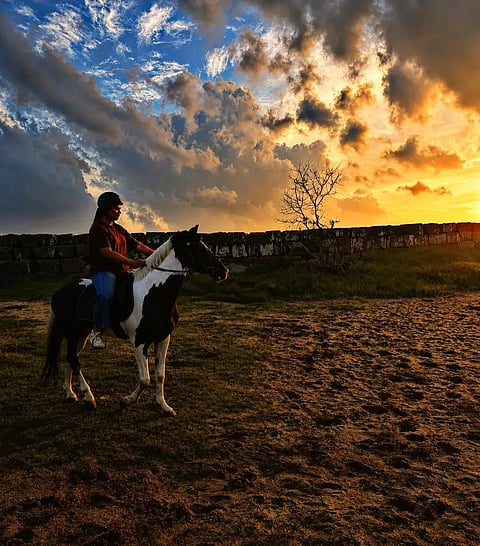

It began with a pony video on YouTube. Archa Krishnan and her sister Aswathy watched it, fell in love with the idea, and persuaded their father to buy “a cute horse” as a household pet.
Sounds bizarre? Their neighbours and extended family thought so. Why would two young women need a horse at home?
The teenage sisters learned to ride anyway. Before long, their white horses had become the neighbourhood’s main character. Evening rides along village roads drew curious children, followed by parents with the inevitable question: could their children learn too?
What began as “a family eccentricity” gradually evolved into Kedar Horses, an academy in Kollam that has now trained around 150 students.
Archa and Aswathy’s story reflects a trotting trend in Kerala. Horse riding is no longer seen as an elite pastime. Rather, newcomers are drawn by curiosity, screen fatigue, social isolation, fitness goals, a love for animals, or simply the thrill of trying something unusual.
Riding clubs have been cropping up across the state, and trainers say enquiries have risen steadily. Students include children, women and working professionals.
“Today, people spend so much time on digital screens that they are looking for ways to disconnect, clear their minds and reconnect with the natural world,” says Riyas Mohammad, owner of G-Farm in Thiruvananthapuram.
“Because of this, horse riding is changing from a simple hobby into a form of therapeutic activity. It is a sporty medium to help people reconnect with nature in a raw but elegant way.”
That idea of riding as a mental reset comes up repeatedly among trainers. Unlike many forms of exercise and mindfulness activities, there is no room for distraction here.
Riders must constantly observe the animal, give instructions, maintain balance, anticipate movement and react instantly. The horse, unlike a gym machine, has a mind of its own. Quite opinionated they can be.
Roy K S of Black Stallion Academy in Kochi says adult beginners and women now make up a significant share of new learners. For him, the attraction extends well beyond riding.
“Spending dedicated time interacting with horses, such as giving them treats, provides deep mental relaxation, stress relief and a unique emotional bond,” he says.

At Elegant Hooves Horse Riding Academy in Kochi, Sreerag S Lal says many students are searching for a hobby that breaks away from the conventional fitness routine.
“On a physical level, riding acts as an intense full-body workout, engaging deep muscles that traditional gym routines often miss. A structured one-hour session combining walking, trotting and cantering can burn up to 650 calories for a rider,” he says.
“Mentally, controlling an animal a hundred times stronger than oneself builds confidence, reduces psychological stress and sharpens reflexes by accelerating decision-making. It also fosters emotional connections, helping riders develop empathy through a genuine bond with a living being.”
He adds that horsemanship goes far beyond sitting in the saddle. “Mastering riding on one specific horse does not mean a student can seamlessly ride another,” he says.
“True horsemanship requires learning how to approach a new animal, allowing it to register the rider’s scent, offering treats, and establishing mutual comfort.”
Dr Shameer N M of Bright Horse Riders’ Club in Thiruvananthapuram says the sharpest rise in enrolments over the past year has come from women. His clients include doctors, engineers, VSSC personnel and professionals from Technopark and UST Global, many of whom ride to unwind after work.
“The idea was to disconnect children from phone addiction and give them something active and thrilling,” says Dr Shameer.
His interest in equestrian training has also extended to Bright Central School, the CBSE school he runs, where all students receive horse-riding lessons free of cost.
He says interest in the sport has grown rapidly, with several new equestrian clubs opening across Kerala over the past couple of years.
Course fees vary, but a 10-day programme with one-hour daily sessions typically costs between `5,000 and `15,000 across Kerala.
The therapeutic side of riding is also drawing attention. Dr Shameer points to the globally popular hippotherapy, which uses a horse’s natural rhythmic movement to support physical and neurological development.
“For children affected by autism, structured interaction with horses brings positive changes in bodily balance and sensory coordination,” he says.
The growing fascination has also led to more enquiries about owning horses as pets. Since horses are classified as domestic animals, they do not require a special licence.
But trainers are quick to add a word of caution: unlike dogs or cats, horses demand considerable space, daily exercise, specialised feed, grooming, shoeing, experienced handling and regular veterinary care.
What about the cost? A horse can be priced anywhere from `15,000 to several lakhs, based on pedigree and features.
Archa says feed alone costs at least `200 a day. Sreerag estimates overall monthly maintenance at around `10,000, including stable care and shoeing.
Native Indian breeds such as Marwari and Kathiawari adapt better to Kerala’s climate, Archa says, while foreign breeds require greater care.
Retired English Thoroughbreds (former racing horses), she adds, are often favoured by riding schools because they are disciplined and respond well to commands.
For Renjith Ramachandran, director of IVA at Technopark, horse riding began with fear. Approaching such a large animal felt intimidating. But after meeting Riyas and visiting his farm, he gradually took to beachside riding sessions. Today, early morning rides at St Andrews Beach have become part of his routine.
“Riding a horse on a clean beach gives a calm feeling,” says Renjith. “A horse can sense our mood. If it becomes close to us, it understands us, sometimes even more than dogs. After that, command is not always necessary.”
Part of the appeal, he says, is the old-world aura surrounding the sport. “Civil servants are also trained in horse riding because it builds leadership qualities. There is a saying that if you can control a horse, you can control an entire district,” he smiles. “This idea can be applied to our lives as well.”
Renjith hopes to own a horse one day, though he admits the costs are daunting. “It needs a lot of space, care and money,” he says. “That is why academies that offer boarding are useful. Owners can pay a monthly maintenance fee while the academy looks after the horse properly.”
Clearly, from YouTube videos to sunrise rides along beaches, horse riding is quietly shedding its image as an aristocratic activity. For a growing number of Malayalis, the saddle is becoming something else entirely — a route to fitness, companionship, mindfulness and, perhaps, a brief escape from a life increasingly lived through screens.
Inputs from Bhagya A B