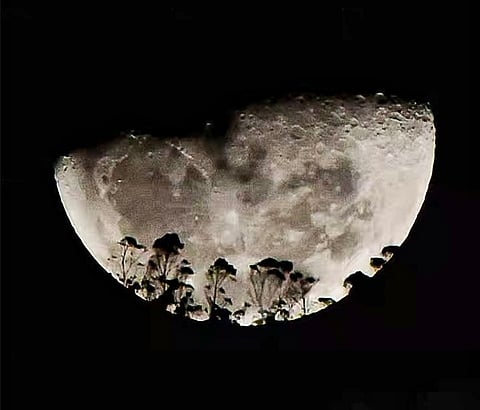

It all started with two PVC pipes for Sarath Prabhav.
While in Class XII, he fashioned the pipes into a homemade telescope using lenses purchased from the market. It was a longtime dream — to see the moon in all its glory.
Back then, a camera was a luxury for a schoolboy, and mobile phone cameras were still in their infancy. So he would borrow his friends’ phones and photograph the moon through the telescope. “Grainy snaps,” he laughs.
Yet, the moon kept calling him. “I experienced a high as I slowly began discovering the details — the craters, the hills and so on,” he says.
Sarath’s fascination deepened at the Thiruvananthapuram Planetarium, where he became a regular at its evening stargazing sessions.
“There, the telescope opened up a whole new world. I started staying back late just to get a better look at the moon and the stars,” he says.
The boy with the homemade telescope would eventually become a trainer in astro-tourism and astrophotography.
Sarath is not alone. Like him, Rohith K A, a software engineer, also began chasing the moon at a young age. “It is the most accessible celestial body,” he says. “You can see it with the naked eye and capture it even with a smartphone.”
As a child, he had heard stories about the rabbit on the moon. “But when I first looked through a telescope, I saw the craters and the shadows. Quite dreamy... way more fascinating than the rabbit,” he laughs.
For Rohith, the moon was only the beginning. “For most astrophotographers, the moon is the starting point of discovering the enigmatic mysteries of the deep sky,” he says.

Today, Rohith zooms in on comets, nebulae and the Milky Way. “There’s so much to discover in the night sky,” he gushes with childlike excitement.
Even so, the moon remains irresistible. A thing of beauty, after all, is a joy forever. “The waning phases, eclipses, the supermoon... though familiar, it reveals something new with every click. One can’t just get enough of it,” he smiles.
During a lunar eclipse, he gushes, it turns a “mesmerising shade of red”.
“And during a solar eclipse, watching the ring of fire form is just amazing. I was in the Andaman Islands during the last solar eclipse. I will never forget that moment.”
For Sarath, moon photography eventually became a gateway to something much larger. “Initially, my interest was rooted in the cultural aspects,” he says.
“Finding our birth stars in the sky fascinated me. Science reveals endless cosmic beauty, mysteries and puzzles.”
While Sarath and Rohith found their calling through Aastro Kerala, orthopaedic surgeon Dr Sri Ganesh rediscovered his passion through the Ahalia Astronomy Club.
Along with friends, such as astronomer Shamin Parari, and the Ahalia Group of Institutions in Palakkad, he helped establish the club a decade ago.
“We conduct weekly public stargazing and astronomy sessions,” says Dr Ganesh.
“The journey into the cosmos begins with the moon. You start by observing it with the naked eye, then with cameras, and later through a telescope. Before long, you’re discovering far greater wonders.”
Getting started, he says, is surprisingly simple. “A DSLR with good zoom and focus, along with a sturdy tripod, is enough for basic moon photography.”
A telescope, however, reveals far finer detail. One could even build one using PVC pipes, as Sarath once did.
“Eventually, however, most enthusiasts end up buying a professional one,” he says.
Then comes the next mission: photographing the mineral moon. “Different minerals on its surface produce subtle reddish and bluish hues. Capturing those colours, however, is toilsome,” says Dr Ganesh.
Doing so requires thousands of images taken in rapid succession and stacked together using specialised software.
Sarath explains the process simply. “We usually record videos using sophisticated equipment. At 24 frames a second, we get thousands of individual frames,” he says.
“We stack them so that each contributes a tiny detail. After hours of processing, a moon that was never visible to the naked eye emerges.”
Beauty beyond what the naked eye can appreciate. This is what hooked astro-landscape photographer Navaneeth Unnikrishnan as well.
“The moon can be photographed from almost anywhere, but its character changes dramatically beneath darker, less polluted skies,” he says.
Getting the perfect shot, however, is anything but easy. “The moon is intensely bright against a dark sky, creating a dynamic range that’s difficult to capture in a single frame,” Navneeth explains.
“Atmospheric turbulence softens fine details. The Earth’s rotation demands precise shutter speeds or tracking mounts, especially with long focal-length telescopes. And achieving perfect focus at such magnifications is incredibly challenging. Even tiny vibrations or optical imperfections can blur the crater textures.”
His passion has taken him across the world. He has photographed the moon above snow-covered mountains in New Zealand and beneath the pink-and-green glow of the aurora borealis in Sweden.
Yet his favourite memory is of a moon he never photographed. A crescent moon rising over a placid lake in New Zealand.
“An orange moon on the horizon in the wee hours. Its glow shimmering on the water. It felt like a poem coming alive — or a fantasy beyond my imagination,” he smiles.
He did not raise his camera. “I didn’t have the right equipment,” he says. “And honestly, I didn’t feel like trying. Some moments are meant only for your own eyes.”
Perhaps that’s what it really means to be moonstruck.