
One of my fondest football memories is of long, inky shadows flitting through the warm orange glow of streetlights on a silent lane in Khayelitsha, near Cape Town.
Shadows, shrieks, and a football.
These vivid images return every time I thumb through my diary from the 2010 World Cup in South Africa.
The notes were written from a shack in Khayelitsha, a vestige of apartheid. Set up in the 1980s to segregate Black South Africans, it was a township of exclusion dotted with tin-roofed shanties, infamous for penury, power shortages, and pathos.
Yet, that evening, none of it seemed to matter. Only football. And possibilities.
The boys belonged to a generation inspired by South Africa becoming the first African nation to host the World Cup. They played with abandon.
After all, a day earlier, Siphiwe Tshabalala had scored the opening goal of the tournament. South Africa held Mexico to a 1-1 draw. They did the Diski Dance. Vuvuzelas blared.
Football, considered predominantly a Black sport, felt like liberation. A catharsis of the sporting kind.
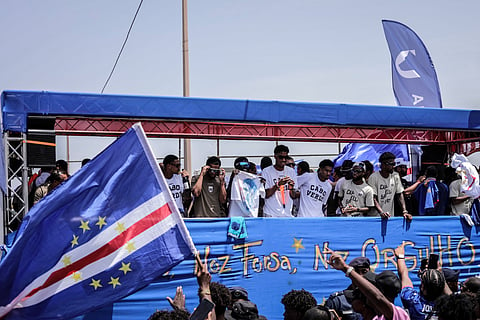
Sixteen years later, Cabo Verde’s tour de force brought those shadows back to me. The same sense of audacity. The same sense of fortitude.
Morabeza, sodade , revolution...
Their fantastic run in the World Cup was not just about results. It was about arriving.
And then came the ripple effect. People who had never heard of Cabo Verde began looking it up. What is ‘morabeza’? Why does the word ‘sodade’ carry so much emotion? Who was Amilcar Cabral?
That is what a World Cup can do. It can turn a team into cultural ambassadors.
For those who have not read up yet, ‘morabeza’ has no perfect English equivalent. It is warmth and hospitality. An embrace of an unhurried life. Chill.
‘Sodade’, meanwhile, is a deep, aching longing for people and places left behind. It echoes through Cabo Verdean music, capturing the archipelago’s long history of migration in search of employment opportunities.
And Cabral was a nationalist. A revolutionary, intellectual, and poet. One of Africa’s foremost anti-colonial heroes, his ideals guided the independence movement of Guinea-Bissau and Cabo Verde.
For many, this World Cup was the first encounter with Cabo Verde. It will certainly not be the last.
Over 10,000km away, here in Kerala too, Cabo Verde has garnered a new fanbase amid all the traditional rivalries. Not many World Cup conversations are complete without a mention of the team’s stunning campaign — 0-0 against Spain, 2-2 against Uruguay, 0-0 against South Africa, and 2-3 against Argentina.
“There is something lovable about them,” says Uber driver Daniel T A, giving a synopsis of football chit-chats in his car over the past couple of weeks. “I heard that the country’s population is just about 5.3 lakh. There can be no limitations when there is real passion, right?”
Echoing the sentiment, software engineer Renjith Maxy says that despite being a “hardcore Argentina fan”, he wanted Cabo Verde to beat Messi & Co in the thrilling clash.

“They really played well — pushing all their mighty opponents to the limit. Moreover, several of their players are from the diaspora. They returned to play for their country. One of them, centre-back Roberto ‘Pico’ Lopes, got a call-up to the national team via LinkedIn,” says Renjith.
“Take their goalkeeper, Vozinha (Josimar Jose Evora Dias). He used to be an electrician and a bus driver. He’s a global superstar now. Such stories make the team really endearing.”
Notably, Cabo Verde assistant coach Humberto Bettencourt himself was once a carpenter and metalworker. In a recent interview with Olympics.com, he recalled: “Growing up, my mother never liked me playing football. As a child and teenager, I played with my friends in secret because whenever she found out, she would scold me. She’d say football wouldn’t amount to anything and wouldn’t put food on the table.”
He adds that he understands why she felt that way. “We lived in a rural area that didn’t even have electricity. There were no televisions — only the radio,” he says. “A lack of information often breeds fear: fear of the unknown, fear of a child leaving their comfort zone.”
Years later, Humberto became coach of a local club. But he lacked formal technical knowledge.
“I started reading everything I could. I had to go to internet cafes because I didn’t have internet at home. I spent hours there searching for information,” says the 51-year-old, adding that a turning point came in the form of an Olympic Solidarity scholarship for advanced coaching education.
‘Everything built from a dream’
Humberto joined the national team in 2020. Cabo Verde, he notes, has experienced continuous waves of emigration throughout its history. Yet its emigrants, and later their children and grandchildren, never lost their bond with the islands.
He made reconnecting with that shared identity central to the team’s journey. Players from the diaspora were encouraged to see themselves not as outsiders. “We showed them how important it was to represent Cabo Verde,” he says.
The World Cup heroics, Humberto believes, have changed how the world sees his country. “There is a Cabo Verde before the World Cup and a Cabo Verde after the World Cup,” he says.
Humberto reveals that his guiding philosophy came from a sports psychology book by Joao Cidral: “Use your mind to win.”
“Everything was built from a dream — a dream shared by many people over many years,” he says.
That’s what Cabo Verde has inspired many to do. To dream.
Police officer Harishbabu M, a former footballer, turns emotional as he speaks about it. “I am reminded of my college days, my teammates. I still remember a prodigy who lived in a ramshackle tarpaulin hut back then,” he says.
“We had so much talent here in Kerala. We still have. So many dreams. But, unfortunately, dreams are snuffed out young here. There was a sense of release and solidarity when I watched Cabo Verde.”This sense of a personal high resonates in the words of physical education trainer Krishna Chandran T C too. “I was reminded of my football coaching days,” he says.
“Cabo Verde’s performance and attitude will serve as a lesson in future coaching sessions for sure. We have the potential. Look at the Minerva FC U-12 team that lifted the Gothia Cup in Sweden a few days ago. They represented India, and beat international teams. Now, we need to push to the next level.”
Football coach Vimal Konary concurs. “What impressed me the most about Cabo Verde was their grit. Even while taking on giants of the game, they hardly looked unnerved,” he says.
“In local lingo, we call it ‘otta mind’. Nothing more to say. That’s what I am going to drill into the minds of my players.”
Message for India
This should be the biggest takeaway for India, believes sports commentator and leadership consultant Sreeduth S Pillai.
“First, let me be frank, I had never heard of Cabo Verde until this World Cup. Their performance made me sit up and take note. And I am clearly not the only one. That’s what sports can do to a nation. Apparently, even tourism interest in this tiny speck on the globe has spiked,” he says.
“Cabo Verde’s population is less than the daily ridership of Mumbai’s suburban railways. But look at how they have won hearts across the globe. India, with a population of 1.35 billion, has a message here: focus, invest in the grassroots.”
Sreeduth concludes with a life lesson. “Look at Vozinha. He is 40. He once did odd jobs to make ends meet,” he says.
“During this World Cup, after the clash with Argentina, Lionel Messi hugged him and said: ‘You are great. Your people should be proud of you.’ Well, perseverance pays. You never know what’s in store for you round the corner.”
On that note, let me sum up. It is clear that success in a sport is never measured only by trophies. It is measured by the inspiration radiated to show up and ‘play’. And to come out of the shadows.