
The landscape of Kottayam district, rich in cultural history and environmental beauty, is shaped by a river that has sustained generations.
The Meenachil River, better known as Meenachilar, is more than a waterway. It is memory, history and, for many, an idea of home.
Rising in the hill ranges of Ilaveezhapoonchira, this lifeline of Kottayam flows through Meenachil Taluk, passing towns such as Erattupetta and Pala before emptying into the Vembanad Lake at Kumarakom.
Immortalised almost as a character in Arundhati Roy’s ‘The God of Small Things’, the Meenachilar continues to shape the lives of those who live along its banks. Dramatist Abheesh Sasidharan is one of them.
Over the past decade, Abheesh has travelled the length of the Meenachilar, through the villages and towns along its banks, searching for the stories carried by its gurgling waters.
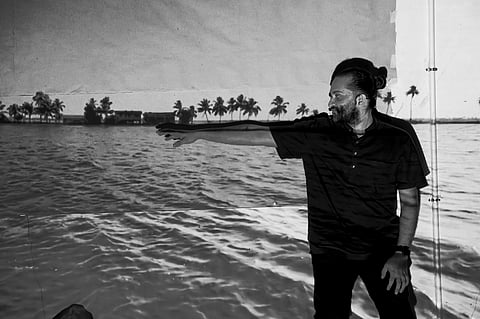
What began as an attempt to trace his own relationship with the river has evolved into ‘Meenachil R’, a 90-minute play that blends an intimate story of personal growth with the course of the river and its lesser-known history, including the forgotten accounts of the slave trade in Kerala.
The play — an experimental solo, first-person narrative — begins with stories from his childhood and adulthood, deeply tied to the rhythms and ripples of the river.
Abheesh revisits his life through a photograph of himself and his mother standing on the riverbank.
As he leads the audience through his memories, he becomes the little boy who ran to the river and dipped his face into its waters to calm himself after being scolded by his mother.

He then transforms into the teenager who skips classes with his friends and loiters along the river ghats, and finally into the adult who returns in search of histories hidden beneath the shimmer of those same waters.
Midway, the narrative takes an unexpected turn, much like the Meenachilar’s tributaries, into the painful history of the slave markets and trade that once flourished along its banks.
“The initial idea began as a personal account of my life with the river, starting with the memory of a photograph of me and my mother standing on its banks,” says Abheesh, who has completed over 20 performances of the play across India.
“During the preparation of the play, these pathbreaking historical revelations started gaining attention in the state, and I felt the story would be incomplete otherwise.”
Interestingly, the ‘R’ in the title of the play stands for river and the shorthand for archives in cataloguing. In the multimedia production, he uses stones and silt from the riverbank as mediums that carry the soul of the river.
The performance draws the audience in through props, projections and LED lighting as Abheesh repeatedly breaks and rebuilds the fourth wall, shifting seamlessly between the personal and the historical.
He turns members of the audience into characters, hands them props and constantly seeks their responses to the subjects being explored.
“The play is an archive of my experiences with the river,” says the artist, who spent more than a year travelling along the Meenachilar while researching the production.
“Every great civilisation has been built and destroyed by rivers. There are countless stories and myths surrounding Meenachilar. But that sense of nostalgia begins to crumble when one engages with its true history.”
Against the backdrop of the river flowing like a blue vein, the play recounts the story of two slaves sold in the markets of Pala. They escape their shackles and eventually establish a settlement of their own — Manjadikkari.
Once a crocodile-infested marsh, it became a place where people struggled against the odds to build a new community. The story draws from ‘Manjadikkari – Olichottathinte Vimochana Daivasasthram’ by historian Vinil Paul, who has played a pioneering role in documenting the history of the slave trade on the Kerala coast.
Lauding the play, Vinil says: “The performance blends personal history with environmental history, caste and slavery, themes that are rarely explored in popular Malayalam theatre. It also connects local history with global history as the play ends on the black sands from the estuary.”
Vinil adds that scholars from the Netherlands made some disturbing discoveries in 2015.
“They accessed port registers from colonial Kochi that revealed records of the sale of thousands of people through international waters,” he says.
“This fundamentally altered our understanding of Kerala’s past. The play reflects that shift very effectively.”
The history of the slave trade remained a subject of debate in India for decades because oral histories were rarely supported by documentary evidence. Several historians say the Marxist tradition of historiography in Kerala often overlooked slavery within the broader history of labour.
“Slave markets existed across the state during the pre-colonial period, linked to agricultural labour and religious institutions. With the arrival of the Portuguese and the Dutch, they expanded into overseas trade,” Vinil notes.
“Many people were sent from Kochi to places such as South Africa, Mauritius and England. They came from different caste groups, contrary to the common perception that only the so-called lower-caste communities were affected. Evidence survives in Dutch archives in Kochi, records of debates in the British Parliament on the slave trade in the Malabar region, and gazette archives in South Africa carrying advertisements offering slaves from Kochi for sale as household property.”
Abheesh says his attempt is to spotlight this hidden history. “Let there be conversations,” he smiles.
In its closing scene, he stands on Thottappally beach, once a major gateway for trade during the early colonial period.
He hands the audience a fistful of wet black sand collected from the shore.
“As I stand here, I feel that the clouds and the wind bring back to me countless voices of abducted lives that were taken away from these lands,”
he says, staring at the horizon.