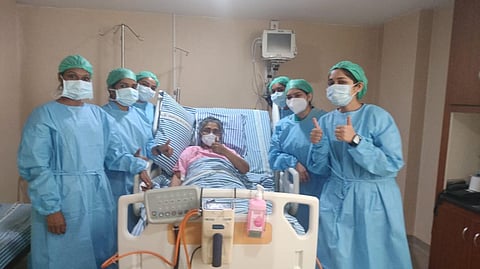

For nearly two years, 68-year-old Meena (name changed) battled lymphoma, a form of blood cancer, with little sign of improvement. Bedridden and unable to move, she had stopped responding to medicines despite multiple rounds of treatment.
“She was struggling. Often, people lose hope at that age and simply surrender. But we kept looking for treatment options that could help her get back to a normal life,” her husband recalls.
Meena had been undergoing treatment at Medical Trust Hospital in Kochi, where doctors had exhausted conventional options.
“She was under palliative care. We had tried several treatment approaches, and a bone marrow transplant was not possible because she was bedridden,” says Dr Varun Rajan, senior oncologist at the hospital.
A new possibility emerged in October 2023, when CAR T-cell therapy was approved in India.
The treatment, formally known as chimeric antigen receptor (CAR) T-cell therapy, genetically modifies a patient’s own immune cells to recognise and destroy cancer cells.
It has been used internationally since 2017 to treat certain blood cancers, including specific types of leukaemia, lymphoma and multiple myeloma.
“We discussed this new option with the family, and they were willing to proceed. Since the therapy had only recently been approved and had not yet been performed in Kerala, we also had to undergo specialised training,” Dr Varun recalls.
He travelled to Tata Memorial Hospital to train in the procedure before returning to Kochi to perform the therapy.
“The patient was in an extremely advanced stage of illness. She had lost mobility and was confined to bed. Successfully administering CAR T-cell therapy in such a severe clinical condition was not easy,” says Dr Varun.
Before opting for the new treatment, Meena had undergone seven cycles of chemotherapy.
“Once the doctors suggested CAR T-cell therapy, we discussed it as a family and decided to go ahead,” her husband said.
“Within three weeks of the procedure, she started recovering. Physiotherapy was continued alongside the treatment to help restore her mobility. Today, she can walk independently without any support.”
For Dr Varun, her recovery carries a larger message. “The treatment was completed in December 2024. Eighteen months later, with regular follow-up and close monitoring, Meena remains in remission,” he says.
“Age alone should never decide whether a patient deserves a chance. With the right medical care, even patients in advanced stages of disease can bounce back to life.”
