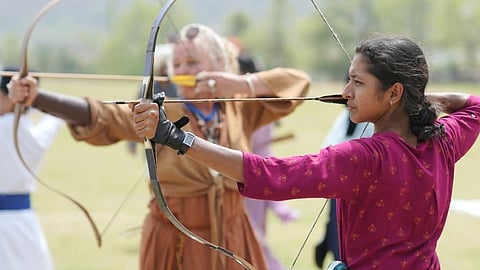

I held a traditional bow for the first time at a recent workshop hosted by Agasthyam Kalari in Thiruvananthapuram. Instinctively, I slung it over my shoulder, striking the pose of the warriors I had grown up reading about.
Lord Shiva (Adi Dhanurdhar), Lord Rama, Arjuna, Karna, Ekalavya — the bow had always belonged to legends I grew up listening to. To finally hold one felt exhilarating.
Around me, everyone else was learning to grip the bow, steady themselves and send an arrow towards a target.
The scene reflects a wider revival. Across Kerala, traditional archery is reappearing through workshops, festivals, and kalari training, with core concepts being simplicity, meditative focus and heritage.
Leading the effort is the Indo-Vedic Traditional Archery Association (ITAA), which documents traditions, trains instructors and connects practitioners across India.
For ITAA vice-president Pravin Ramachandran, however, the journey began far from Kerala — in Sharjah, where he trained at a shooting club before learning from traditional archers elsewhere in the Gulf.
What fascinated him was archery stripped to its essentials — bow, arrow, archer and target, without sights, pulleys or elaborate equipment.
Curiosity soon drew him towards the archery described in Indian epics and martial texts. “There were no resources. Then I realised I might have to explore deeper,” he recalls.
That search brought in filmmaker Martin V George. Together they travelled across 14 states documenting India’s surviving archery traditions for their six-part series titled ‘The Way of the Bow – Urban Hermit’.
“I was interested in the journey and meeting people. Pravin was discovering techniques, and I was capturing those moments,” Martin says.

“We found several Adivasi communities where archery had long been part of life, including the Kurichiya, Kuruma and Kanikkar communities of Kerala. Yet almost everywhere, the practice was fading. Among the Kuruma, for instance, a bow and arrow were once placed with the deceased as part of the funeral rites. Even that custom is now disappearing.”
Their travels revealed two distinct inheritances. One was hunting and survival archery, preserved within Adivasi communities through oral transmission. The other was ‘Dhanurvidya’, a martial discipline passed down through texts and teacher-disciple lineages.
“When we began documenting traditional archery, the first practitioners we found were tribal archers because the knowledge had travelled directly from one generation to the next,” Pravin notes.
“But oral traditions are fragile. If one generation stops practising, the knowledge can disappear. It is like culinary skills and secrets.”
That concern now prompted the association to organise festivals, tournaments, bow-making, documentation, and teacher training.
Equally important, Pravin adds, is resisting the temptation to pack India’s many traditions into a single framework. “We did not want to standardise the teaching. Diversity is the beauty of it,” he says.
“I have immense respect for Dhanurvidya as a martial tradition, and equal respect for tribal archery. They are not in competition. They are different schools of learning.”
Documenting surviving traditions answered some questions. It also raised a more fundamental one: if India inspired some of the world’s greatest archery stories, why was there no clearly recognised Indian bow today?
Enter lawyer Jasminder Pal Singh. Some years ago, after a bow he owned broke, he searched for a replacement. That led to a study on Korean, Chinese and Mongolian bows.
Then a Korean bow-maker asked him a question that changed everything: “Where is the Indian bow?”
Jasminder, who was recently in Kerala, says: “We had all heard about the bows in the Ramayana and the Mahabharata. People abroad even spoke of being inspired by Indian archery. But when they asked what kind of bows India had, I had no answer.”
Soon, the Chandigarh native immersed himself in Dhanurvidya, learnt bow-making, published educational videos and connected with practitioners across the country.
Those efforts eventually led to the formation of ITAA in 2023. For Jasminder, who heads the association, revival must rest on evidence rather than nostalgia.
“We want everything with proof. I am a lawyer, and I need evidence. We are looking at Dhanurveda or Dhanurvidya through the eye of a warrior — not as a circus, not as entertainment,” he says.
Moreover, reviving traditional archery means more than reconstructing old bows or decoding ancient texts. It also means reimagining how the discipline is practised today.
Archers at ITAA tournaments encounter changing distances, unfamiliar positions, three-dimensional targets and penalty zones. Organisers are even exploring contests inspired by the archery challenges of ancient ‘swayamvaram’ challenges.
“A good archer is not someone who has practised one target repeatedly. It is someone who can use the bow when the situation becomes unfamiliar,” Pravin says.
“The only person you are competing with is yourself. You may shoot brilliantly today and miss tomorrow. That is why humility becomes part of an archer’s character.”
Traditional bows, he adds, are inexpensive, locally made and require little equipment. This makes the sport quite accessible.
“Why did cricket become so popular? Because it could be played on the street. Archery also has to be brought down to its basics. You should be able to begin with a bow, an arrow and yourself,” says Pravin.
For beginners, the appeal lies beyond competition. Pravin describes archery as “a meditative practice that demands presence rather than forceful concentration”.
“Concepts such as target, focus, practice, discipline and resilience will naturally start influencing one’s character and daily approach to life as well,” he adds. “In simple terms, the warrior spirit.”
This philosophy is already moving beyond research and into practice. “Kerala has become one of the movement’s active centres. The Way of the Bow Festival recently brought together
Adivasi archers and Dhanurvidya practitioners. Sessions at Playfest in Thiruvananthapuram introduced around 40 participants to traditional archery,” says Pravin.
“We have also conducted workshops at Olam by the Lake in Kochi. Our next goal is to set up traditional archery ranges in Athirappilly and Munnar.”
Meanwhile, at Agasthyam, ITAA is working with Kalari ace S Mahesh Gurukkal to integrate archery into martial arts training.
“This is how it will expand,” Pravin says. “We need more people who can teach, and those teachers will create more learners, more questions and more research.”
For ITAA, the revival is not about preserving a museum piece. It is a craft, a martial skill and a survival tool that shaped human history.
“The bow stood beside human beings for thousands of years,” says Pravin. “If we are here today, at least one of our ancestors must have depended on it at some point — for
defence or survival.”
Perhaps this is how lost traditions return — by placing an old tool in new hands.