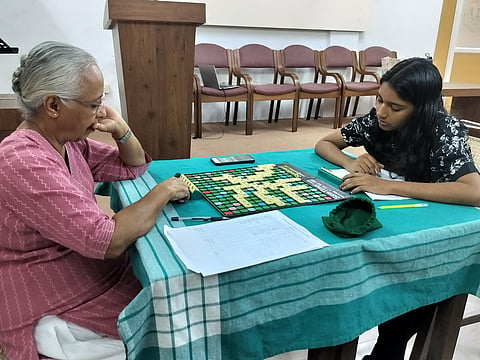

In an age where childhood and youth are increasingly lived through glowing screens, huddling over a board, a bag of letter tiles and a dictionary may seem delightfully old-fashioned.
And therein lies the joy of Scrabble.
One of the biggest attractions of board games is their simplicity. They require little space or physical activity, relying instead on strategy, vocabulary, memory and critical thinking.
Among them, Scrabble has remained one of the world’s most enduring word games. In Kerala too, it has enjoyed a following. But the game was often viewed as ‘elite’ or ‘nerdy’.
Now, a fresh push through schools and community clubs is seeking to bring the game back into the spotlight.
With the first-ever All India School Scrabble Championship set to be held later this year and Kerala hosting its regional round, organisers and enthusiasts hope a new generation rediscovers the timeless appeal of the word game.
Born during the Great Depression
The origins of Scrabble can be traced back to the Great Depression in the US. In 1938, as the country grappled with economic hardship and widespread unemployment, New York architect Alfred Mosher Butts devised the game as a form of entertainment.
He initially called the game ‘It’, before renaming it ‘Lexiko’ and later ‘Criss-Cross Words’. A few years later, James Brunot of Newtown, Connecticut, acquired the manufacturing rights. He refined the game as we know it today.
He called it Scrabble — which means to scratch or claw or grabble frantically — because it “captures the idea of players digging through a bunch of letter tiles to form the right words”.
The game’s popularity surged across the US during the 1950s. Soon it reached homes across the world. By the mid-1980s, Scrabble entered the competitive circuit, with championships being organised in the US.

The Indian story
Scrabble began gaining popularity in India during the 1990s. The Scrabble Association of India (SAI) was established in 2003 and serves as the apex body for clubs across the country.
This year, SAI is hosting its All India School Scrabble Championship, with the Kottayam Scrabble Club set to host the regional qualifiers.
“It is the first time such a championship is being held at the school level in the country. We are conducting workshops and classes in schools across the state to introduce the game,” says Theresa Joseph, a former professor and secretary of the Kottayam Scrabble Club.
Established in 2024, the club has over 80 members aged between 10 and 80, who meet regularly at the Kottayam Public Library.
“The game can be enjoyed by people of all ages and is even part of the school curriculum in several countries. Former US president Barack Obama is also a keen Scrabble enthusiast. He used to play the game with his children as a stress-buster,” says Prof Theresa.
Sam Joseph, founding secretary of SAI, says Scrabble is yet to gain significant momentum in Kerala. A pioneer of the word game in the country, he has trained several players from the state who went on to compete internationally.
“It is a game that enhances vocabulary, mental mathematical skills, memory, cognitive health and spatial reasoning,” says Sam, who is also the director of Team Sam Sports Academy.
“There are about 2.4 lakh words currently registered in the Collins Scrabble Words dictionary (used across the world, except US and Canada). Players only need to learn around 50,000 words to excel at the basic competitive level.”
Unlike earlier times, he adds, players no longer need to carry dictionaries around. “They can simply access online dictionaries and play the game with official rules from home,” he says.
“Awareness about Scrabble remains low in Kerala. We are working hard to change that.”
Agreeing with Sam, mental health and educational consultant Dr Seema Girija Lal says board games such as Scrabble can contribute to a child’s overall development. “Many aspects of the game help develop social skills such as sharing, taking turns and reading the room,” she says.
“It also enhances fine motor skills, creativity, imagination, attention span and focus. Scrabble also aids behavioural development by teaching children patience, acceptance of failure, resilience, self-reliance and emotional regulation.”
A slow but steady rise Scrabble is slowly shaking off the ‘niche’ tag in Kerala. “The game is gaining popularity in cities such as Kochi and Thiruvananthapuram. We have people playing Scrabble at our club. Next, we are hoping to organise tournaments,” says Nadir Hussain of LeSpot Tabletoppers in Kochi.
Mukund V, coordinator of the Trivandrum Board Game Community, echoes the view. “Today, there are many lighter alternatives such as Pun Intended, Chameleon and Fuse instead. Scrabble, however, remains a well-structured game and is ideal for competitive play. It involves more skill and concentration,” he notes.
Prof Theresa, who is thrilled about the upcoming championship, believes such events could become a turning point. “The current youth world champion is an Indian student from Delhi. Unfortunately, we still do not have many players from Kerala competing at the international level,” she said. “We hope to change that.”
Kerala Scrabble Club president Unnikrishnan Panicker M K says efforts are on to engage more children with the game. “I have been playing Scrabble for 40 years, and have trained many children. Parents should encourage children to spend more time on board games,” says the retired pharmacist.
“Besides being an excellent exercise for the brain, Scrabble also serves as a fun medium for family bonding. The best thing about the game is that it can be enjoyed by everyone — from children to homemakers and grandparents.”
Unnikrishnan highlights that the club representatives recently met Education Minister N Samsudheen and presented a petition to introduce Scrabble and chess clubs in schools across the state.
Well, if implemented, the move could prove to be a real ‘game-changer’.
Beginners’ guide
Scrabble is a word game in which two to four players score points by placing letter tiles on a 15×15 game board. The tiles must form interconnected words in crossword style, reading either left to right or top to bottom. Only words included in the approved Scrabble lexicon are accepted. Each player begins with seven letter tiles. The first word must pass through the centre square of the board, after which players build new words using existing letters already on the board.
Every letter carries a specific point value, while special squares on the board multiply either the value of individual letters or entire words. A player who uses all seven tiles in a single turn earns a 50-point bonus.
The player with the highest score at the end of the game wins. The official Scrabble lexicon is updated regularly to include new words and regionally accepted vocabulary from around the world.