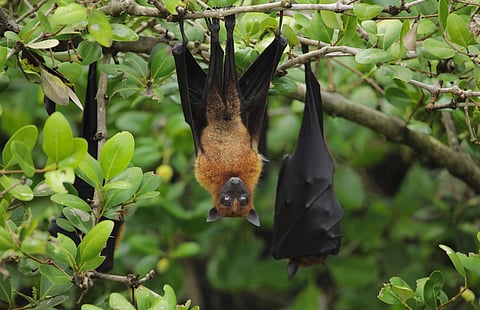

Home to over 1.43 billion people, India is often described as a melting pot of cultures, with umpteen languages, food habits, traditions and lifestyles. However, this diversity is not limited to homosapiens.
With 135 species identified so far, bats form the largest order of mammals in the country. Of these, 16 species are endemic to India. Yet, despite their ecological importance, these nocturnal creatures remain among the least understood animals.
This is the premise of ‘State of India’s Bats’, a new book by 34 researchers from across the country who have been trying to understand these mysterious animals.
Bats are the only mammals capable of true flight, have exceptional disease tolerance, and use sonar systems to hunt. Above all, they play a crucial role in the ecosystem — as seed dispersers, pollinators, and predators of pest insects. The book summarises the basics in the preface itself.
What follows is the product of years of research, but scientists across the country are seeking to understand these creatures. However, for society in general, bats come to mind only when the media screams out Nipah news.
“This is reflected at the government level too,” rues Dr P Balakrishnan, scientist and HoD of Wildlife Biology at the Kerala Forest Research Institute (KFRI). “We only worry about dealing with the disease. And Kerala has developed a state-of-the-art system in the field. But we don’t pay heed to the saying, ‘prevention is better than cure’. For that, we need to study these creatures.”
At KFRI, studies on bats began only recently. A concentrated effort, though minimal, started after the Kozhikode Nipah outbreak and the Covid pandemic.
“The issue is that we are starting from the basics, as only minimal research has been done on these animals in India,” says Nithin Divakar, who has been researching ecological services of bats in southern Western Ghats.
The new book is the result of a resolve to address this lacuna. The project was conceived by Dr Rohit Chakravarty, principal scientist at the Centre for Wildlife Studies (CWS) in Bengaluru.
“He brought together other scientists researching bats. And with two years of effort, we have compiled years of research into this book,” says Nithin.

From collating already established species of bats in the country, their diet, habitats and conservation efforts, to how to move forward with research in “a field with very little funding”, the book touches on almost every aspect.
“One of the many difficult aspects is the field of taxonomy,” says Sreehari Raman, assistant professor at the College of Forestry, Vellanikkara, and researcher at KFRI.
Sreehari has been studying bats in Kerala since 2016. It began with sampling and finding out what species of bats have made the state their home.
“That study took me across Kerala. From forests and caves deep in the Western Ghats to urban dwellings, historical structures, and sacred groves,” he says.
So far, the team of researchers has recorded 48 bat species in the state. Many are yet to be registered due to difficulties in taxonomy.
Several identified bat species were preserved by scientists in the pre-Independence era. And these have been kept in museums and facilities in European countries. These models are not just from India, but many former colonies.
“This lack of accessibility makes determining the species all the more difficult,” Sreehari explains. “The entire process, hence, can take years.”
Nithin, whose sampling trips have also taken him to the wilderness of Meghalaya, highlights another problem: “Lack of funding and the villainisation of bats in society”.
The sampling is a tedious process, the researchers say. Mandatory rabies shots before embarking on the journey could very well be the easiest part.
“You have to wear PPE kits, and gloves are a must,” says Nithin.
Most sampling occurs at night, as bats are nocturnal. So one trip to the field means camping deep inside forests for three to seven days.
The sylvan adventures are not always without danger. “There are times when tigers, leopards, bears, and elephants roam these areas. We rely on guidance from forest officials and tribal watchers. The indigenous communities know the forests inside out,” says Sreehari.
Bats never pose a threat. “The poor creatures never attack humans. They are just shy and stay away from us. It’s we who trouble them,” he adds.
To identify a species, it is often necessary to catch one and study its features. “Because many species look alike, you need detailed information to research later,” says Nithin.
“Multiple species have been incorrectly identified as a single one due to their morphological similarities.”
Tree bats are caught using mist nets, mesh-like nets set up between two poles.
“You set it up in the evening and wait through the night. You won’t catch one on the first day itself,” Sreehari says. “When you get a bat, you detangle it, take photos of its features, measure its wingspan, body weight, etc., and then set it free.”
To study cave-dwelling bats, one enters the caves during daytime to record and study specimens.
“But this is just the surface level. Most bats are not big in size like the fruit bats we commonly encounter. Some can be really tiny — weighing just 2-3g. They live in tiny holes in trees, sometimes between the bark. One needs to be lucky to spot them,” says Sreehari. Another way is to use acoustic bat detectors, which identify bats using sound waves.
The challenge, Nithin says, is sampling urban species. “A PPE kit will scare people off. So we use gloves, masks and goggles,” he smiles.
So, amid all this adventurous research, which also involves nights spent reading about these mammals, have the researchers found out more about the diseases these animals carry?
Efforts are on. “Funding to study bats, their communities and taxonomy is negligible. If there is any money, it all goes to the disease side,” Balakrishnan says.
“That means how these viruses spread to humans remains mostly unknown. Though many talk about fruit bats and eating fruits as reasons, these are not conclusive.”
But that doesn’t mean the team is stopping. To aid research on antibodies in bats, Sreehari has been collecting saliva and blood samples from bats since January and sending them to the National Centre for Biological Sciences in Bengaluru.
“And if you ask how the virus spillover happens, the existing theory is stress,” Balakrishnan explains.
“Habitat loss, when roosting sites such as trees are cut down, and environmental challenges like rising temperatures instil a high amount of stress in these species, many of which are communal animals. This triggers the spillover — not just to humans, but also to other animals such as pigs, rodents, cats and dogs.”
Nithin cites an example of Nipah spreading in Malaysia through pigs. “To prevent future outbreaks, what we actually shouldn’t do is cull bats and destroy their habitats. They can have a deeper ecological impact and be counterproductive,” he says.
Instead, the team asks governments to provide more funding for research and to develop a comprehensive policy, like those in countries such as the UK, to ensure bat roosting sites remain undisturbed during development activities.
It ultimately is a community effort, they remind, while reiterating that prevention is better than cure, and the first step of ‘prevention’ is understanding the basics. In this case, the bats.
Bat points
1,500 species worldwide
135 in India
48 in Kerala
Challenges
Threats faced by bats:
Human population growth
Expanding urbanisation
Human-bat conflict
Climate change
The new book
‘State of Bats in India’ — published by Bat Conservation International (BCI) and Nature Conservation Foundation (NCF)
Why study bats
Bats help with pest control in agriculture
Important for pollination and dispersing seeds
Crucial for forest regeneration
Their exceptional disease tolerance — despite being carriers of viruses such as Nipah — is of immense research value
More backing for research needed
Despite their crucial roles in the ecosystem and the variety of antibodies that they contain, bats receive little attention from research and conservation communities and scant recognition in government policies and programmes. So much so that there are fewer than 50 dedicated bat researchers in India.