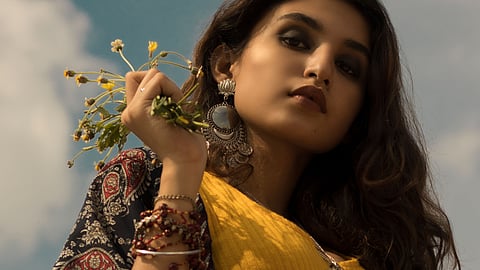

Chatpata is the latest buzzword taking over the Indian fashion world. Borrowing its name from the Hindi word chatpata — used to describe food that is tangy, spicy, and packed with flavour — the trend brings the same energy to clothing.
Vibrant, playful, and unapologetically bold, the aesthetic celebrates Indian elements such as sheer fabrics, mirror work, gota patti, zari, bandhani, hand embroidery, and flowing georgette kurtis, all of which are finding favour with a new generation.
The heady fusion is not limited to hipsters alone anymore. With more than 1,20,000 posts under #chatpata on Instagram, the trend has gained momentum as Gen Z revisits the fashion influences of the 2000s and early 2010s. After all, ‘desi’ has been in vogue across spheres. ‘Root’ is cute, they say.
“Western culture has long influenced our wardrobes. Modern Western fashion popularised a minimalist aesthetic built around neutral shades such as beige, grey, black, and white,” says college student Keerthana Bhairav.
“For a while, many Gen Z fashion choices began to look alike, with oversized blazers, white crop tops, and clean sneakers becoming the go-to uniform. It was cute, but somewhere along the way, we forgot how cool Indian fashion was.”
She believes the clean-girl aesthetic and polished neutral palettes feel bland compared to the richness of Indian styles. “For a long time, Western fashion was viewed as the default standard of sophistication. Now, our generation is becoming more confident about expressing its culture through what it wears,” says Keerthana.
Across India, the trend has transformed getting dressed into a more playful exercise. The goal is no longer to look perfectly put together but to create unexpected combinations. The more personality an outfit has, the better.

Adhila Fathima, a self-described fashion maximalist, takes an anything-goes approach to dressing. “My wildest combination is probably a saree with boots and three dozen kuppivala (glass bangles) on both hands,” she says.
For her, reserving cultural clothing for weddings and festivals no longer makes sense. “I love wearing these pieces on ordinary days. It makes the day feel lighter and more joyful,” she jingles.
Accessories, too, are getting the chatpata treatment. Septum rings inspired by classical dance traditions, raindrop bindis, waist chains, anklets, chunky ear cuffs, and stacks of bangles are becoming part of daily wear rather than occasional adornments.
“Wearing them on a casual date feels fun,” says Keerthana.
Make-up follows the same maximalist mood, with glossy lips, shimmering eyelids, coloured eyeliner, and rhinestones adding an extra dose of drama.
Another factor driving the trend is a culture of reinvention. Many young shoppers now scour street markets, online thrift spaces, and family wardrobes in search of one-of-a-kind pieces.
“Most of my chatpata tops are actually my mother’s old clothes that I have altered and remodelled,” says Keerthana.
Inherited pieces are finding a new lease of life when paired with denim, relaxed silhouettes, and contemporary accessories. The result is a style that feels personal, inventive, and far removed from anything found on a retail rack.
Local boutiques are witnessing the trend firsthand. Across cities such as Kochi and Thiruvananthapuram, designers say young customers are arriving with highly specific references, mood boards, and styling ideas, often seeking pieces that cannot be found in mainstream stores.
At Aham Boutique, designer Dinu Elizabeth Roy notes a growing preference for custom-made clothing. “They want something that feels like theirs,” she says. “Many choose clean, single-coloured bases and then layer them with Indian jewellery pieces. I think it’s that contrast that they enjoy.”
The emphasis is less on following fashion rules and more on creating memorable looks. “What stands out about Gen Z is their confidence. Regardless of skin complexion or body type, they are eager to experiment,” says designer Revathy JayanBabu.
Styles that once raised eyebrows, from halter-necks to strapless blouses, now arrive as routine orders. “People are no longer dressing to hide,” says Revathy.
“They are dressing to express themselves. Personally, I love corsets and spaghetti-strap kurtas, pieces that everyone is now confidently wearing on a daily basis.”
The revival is particularly noticeable in the fabrics making a comeback. Prints such as Bagh and Ajrakh are appearing in contemporary separates, while Madras checks are being cut into skirts, dresses, and cropped tops.
At Kirthi The Boutique, owner Hazari Singh Bhati says customers increasingly ask for Jamdani, Ikkat, block prints, and other handloom textiles, not for traditional outfits but for garments that feel current.
Khadi is another fabric getting a makeover in the chatpata era. Once associated largely with political symbolism and handicraft stores, it is now appearing as crop tops, co-ord sets, jackets, and relaxed separates.
Part of its appeal lies in sustainability, but for many young wearers, khadi offers a sense of character that mass-produced fabrics often lack.
Tapping into renewed interest in the fabric, the Khadi and Village Industries Commission’s Centre of Excellence for Khadi recently launched Swadha, a gender-neutral wellness-wear line.The same instinct for sustainable, budget-friendly, and endlessly repurposable clothing is reshaping formal dressing too. According to Dinu Elizabeth Roy, bridesmaids are increasingly choosing sarees over gowns, favouring outfits that can be reworn, altered, and styled differently
Menswear, too, is getting chatpata. “Young men are bringing vintage family sarees to be transformed into waistcoats, kurtas, and matching sets,” says Swathy Akil of Kochi-based brand Swatling Designer Studio.
“Rather than playing it safe, many are opting for intricate embroidery, stonework, and hand-painted details, replacing the understated styles that were once the norm.”
Gen z men are investing far more time and thought into fashion and grooming than previous generations, notes Sreejith Jeevan, founder of Rouka Studio. “The days when men could afford to be indifferent to style are fading,” he says.
“Many are consciously building a personal style. Their interest in maximalism stems from a desire to create something distinctive”
Oversized Ajrakh shirts paired with cargo pants, embroidered kurtas styled with sneakers, and layers of beaded necklaces, chunky silver rings, and oxidised chains are cropping up more often.
Tangy combinations can even include bohemian dhotis with jazzy Modi kurtas and rudraksh jewellery. Or maybe jeans with jubba that scream traditional Indian motifs.
Chatpata fashion is not one thing but many things stitched together — part nostalgia, part rebellion, and part pure masala. Bring it on, folks!
This story was reported by Bhagya A B for TNIE - Kerala, with inputs from Parvana K B.