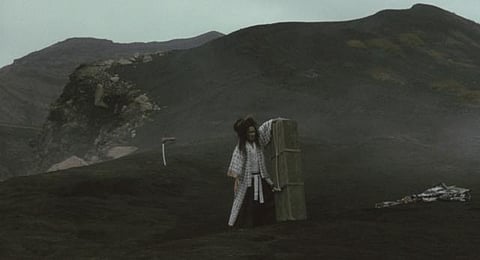

"Be with me always — take any form — drive me mad. Only do not leave me in this abyss, where I cannot find you! Oh, God! It is unutterable! I cannot live without my life! I cannot live without my soul.”
A broken soul’s cry after his beloved’s death. This is what it might have been in anyone else’s ink. But under Emily Jane Bronte’s pen, this desperate plea becomes something darker: it is an all-consuming obsession that destroys everything in its path.
When the famous anti-hero, or in literary terms a Byronic hero, Heathcliff rages after Catherine Earnshaw’s (Cathy) untimely death at the age of 19, he is filled with vengeance and wounded pride tinged with love.
When Brontë published the novel under the pseudonym Ellis Bell in 1847, ‘Wuthering Heights’ received scathing reviews.
The 19th century had already produced many remarkable Gothic works. Yet, the novel shocked readers.
The dark, brooding characters, haunted walls and the wild, moody moor were familiar Gothic elements. What readers had not encountered before were such deeply imperfect protagonists.
Imperfect would be an understatement. The brutality unleashed, the doomed love story driven by revenge, possession and obsession — all of these made readers uncomfortable. Those were times of intense moral scrutiny.
That may well be what set this Brontë sister apart. Though ‘Wuthering Heights’ was her only published novel, she continues to live on among readers today.
Recently, a cinematic ‘adaptation’ of the book was released in theatres. Though raking in money, the “surprise Box Office hit” has drawn some scathing reviews as well. Many felt the ‘adaptation’ did an injustice to the original cult classic.

However, the film has renewed discussions about the book that has inspired several adaptations across the world, including Bollywood.
For Aathira Suresh, a physics student and film buff, the latest film by director Emerald Fennell may be imperfect, but has spurred conversations about the many shades of Brontë’s characters.
“I read ‘Wuthering Heights’ a year ago. I can vividly remember the descriptions,” she says.
“At a time when characters were usually black and white, stories were about good and bad, she offered something raw. That people could be grey, love is not always pure. And though many nowadays call it a romance, it was actually about obsession and revenge, the often unexplored side of love. Brontë showed how wounded pride and obsession can destroy lives.”
Notably, Brontë wrote at a time when women were often treated as little more than possessions. Within the haunting, windswept moorland setting, she also explored themes that resonate with feminist thought, Aathira believes.
Cathy herself is an unlikeable character, full of human flaws and feelings. She is not the typical heroine of the time, someone striving to carve a place in society or seeking goodness in humanity. Instead, she is as imperfect as any other human.
“Selfish, in love, and brimming with desire. Well, both were obsessed, weren’t they?” Aathira smiles.
The story unfolds non-linearly and follows two families through the eyes of two outsiders: Ellen “Nelly” Dean and Mr Lockwood. They are unreliable narrators. One is a long-serving housekeeper who witnessed the lives of both families, the Earnshaws of Wuthering Heights and the Lintons of Thrushcross Grange. The other is a new tenant renting one of the houses.
“This narrative approach makes the story intriguing. Readers do not see much direct interaction between Cathy and Heathcliff. That makes it all the more interesting,” says Archana Gopakumar, founder of The Reading Room in Thiruvananthapuram.
The often-projected image of the gentry is also questioned here. Nelly, the housekeeper, becomes the one narrating their turbulent lives.
“However, beyond a study of characters, their motivations and their breaking moments, ‘Wuthering Heights’ is an atmospheric horror,” Archana says.
“Bronte describes everything — the environment, the moor, the dogs (I love them!), the supernatural, the candlelit dark rooms and the dark corners of the two castle-like homes. That itself makes this book a beautiful read about a ‘beautiful’ disaster.”
The tragedy that hangs over every page unfolds slowly. The art of smothering one so seductively is what has made her pick up the book no fewer than three times.
“And it’s witty when you don’t expect it. The satire shines through when the families interact, while the horror unfolds through a toxic love story,” she smiles.
In today’s language, it would be called a “red flag” relationship. It is a story about “two people we pray never get together”.
Cathy, the heroine who remains ever present even after her death, is a weak woman. Archana recalls a famous line in the book where Cathy explains her love for both her husband, Edgar Linton, and Heathcliff: ‘Nelly, I am Heathcliff!’ she passionately proclaims. ‘He’s more myself than I am. Whatever our souls are made of, his and mine are the same.’
“We see a woman who does not possess her own identity,” Archana says. “We still see many ‘Cathys’ in our society, right?”
Many readers believe ‘Wuthering Heights’ is a feminist telling. A devastating critique of how patriarchy affects both men and women — Heathcliff’s childhood abuse, Cathy’s experiences and the fate of Isabella Linton (Heathcliff’s wife), who runs away from an abusive marriage with her child.
“It is an unapologetic, raw, wild story that examines patriarchy without any reservation,” says Archana.
This is perhaps what keeps the novel relevant even today. Tania Mary Vivera, associate professor of English literature at St Teresa’s College, believes the book’s enduring relevance is reflected in the many adaptations it has inspired.
She highlights another important aspect: Heathcliff’s origins. “He is a foundling whose identity cannot be fully established. He has been portrayed variously as white, wheatish and black in different film versions, none of which satisfied audiences,” she points out.
“Heathcliff is a mixed-race foundling, and that gave him freedom from the shackles of social identity, family name and regional identity. However, above all, it adds to him being misunderstood and mistrusted by everyone.”
Though tragedy lingers, Tania adds, the book ends on a hopeful note. It brings to closure the long line of generational abuse and trauma, and the progression of lonely, isolated, orphaned individuals whose lives toggled between intense love and extreme hatred.
She hopes future readers and the current generation — who will “undoubtedly” fall under the Gothic spell woven by Brontë — will carry that hope after they turn the last page.