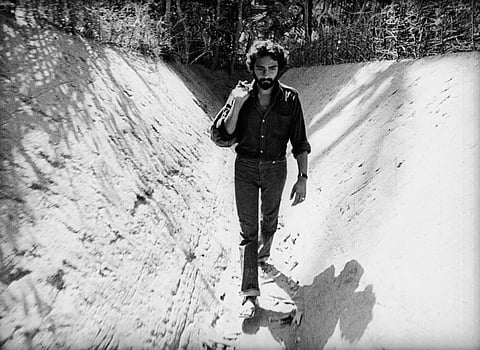

Most films end with their runtime. Some sustain long after the screen goes dark — in film society discussions, classrooms, political conversations and among generations of cinephiles who keep returning to them through rediscovery. ‘Amma Ariyan’ is one of them.
Forty years after maverick filmmaker John Abraham and his Odessa Collective took ‘Amma Ariyan’ across Kerala through a people-funded alternative distribution movement, the cult Malayalam film is now set to reach a new global audience with its restored 4K version premiering at the Cannes Film Festival (May 12 to 23) as India’s only selected feature for a world premiere this year.
Gerald Duchaussoy, head of Cannes Classics, describes the film as “a trip in itself”, adding that he was “blown away by the intensity”.
For a film born outside the structures of mainstream cinema, the journey feels almost poetic. Raw, political and deeply human, ‘Amma Ariyan’ was shaped as much by the people and places around it as by the filmmaker behind it.

Moving between documentary realism and abstract fiction, the film follows a young man’s journey to inform a mother of her son’s death, gradually unfolding into a reflection on ideology, dissent and a generation caught between hope and disillusionment.
Four decades later, its return to the international screen stands as a reminder of a cinematic vision that refused to separate art from the society it emerged from.
Actor Joy Mathew, who played the protagonist (Purushan), recalls meeting John during the final years of the Janakeeya Samskarika Vedi, a radical cultural organisation tied to Left movements in Kerala during the 1980s. According to him, the film emerged from the emotional and political turmoil of that period.
“Many people who were active in the movement got scattered. Some struggled with depression, some died by suicide,” says Joy.
“John was initially planning another film about the Kayyur revolt, but when that didn’t happen, he started thinking about making a film around these experiences and the people affected by them. That is how ‘Amma Ariyan’ took shape.”
For Joy, the experience of making the film went far beyond acting.
“We were involved in everything — collecting ‘bucket fund’ from the public, gathering food from nearby houses, travelling with projectors and screening the film in villages, camping at libraries and public grounds. I even dubbed for several characters because we didn’t have money to bring in junior artistes,” he recalls, adding that John “was a university in every sense”.
The unconventional spirit of the film extended into its filmmaking methods as well. Cinematographer Venu remembers working in difficult and unpredictable conditions, often shooting handheld amidst real crowds.
“We wanted it to feel like reportage, almost like news footage. That’s why there were so many handheld shots,” he says.
“The decision to shoot in 35mm black-and-white — despite colour cinema having become the norm by then — emerged from both practical limitations and aesthetic choices.”
Venu describes the film as a once-in-a-lifetime phenomenon. “It was special in the way it was produced, distributed and shown to people. We stayed in ordinary people’s houses during the shoot. Every day was a unique experience,” he says.
One of his strongest memories from the production was John’s decision to shoot crowd scenes in reverse order. “John knew people would gradually leave during the shoot because we couldn’t hire crowds. So we filmed the larger crowd portions first and slowly reduced them,” he says.
Venu adds he is elated that ‘Amma Ariyan’ is set for a global premiere at Cannes. “New audiences around the world will now discover a filmmaker who lived for his art, using cinema as a form of resistance and idealism,” he says.
“The Film Heritage Foundation handled the restoration with great sensitivity. The team chose not to beautify the film, but to retain its grain, uneven exposure and rough edges.”
Venu bills ‘Amma Ariyan’ as a “rebellion” that challenged the “dominance of capital in filmmaking”.
“The cinéma vérité style emerged organically. We travelled from town to town like a troupe, often not knowing what we would encounter. That unpredictability was both the risk and the excitement,” he says.
Film editor Beena Paul shares the thrill. She remembers first hearing about John while studying at FTII, where he already had a reputation because of his other classic, ‘Agraharathil Kazhuthai’. Later, after moving to Kerala, she became associated with him through Venu, her partner.
“‘Amma Ariyan’ was documentary, fiction, memory and journey all at once. John helped many of us move beyond rigid ideas of cinema and editing,” says Beena.
“His understanding of the medium and even his sense of humour — all of that feels rare to find even now. ‘Amma Ariyan’ was a classic in every sense. I don’t know if a film like that can be made today.”
Echoing the view, veteran film critic C S Venkiteswaran describes the film as a journey. “It travels through the ruins of radical movements, through memories of violence, loss and disillusionment. Structurally too, it was ahead of its time. It was never interested in a conventional plot or linear storytelling,” he notes.
He also points to the film’s “restless visual energy”, especially the fluid handheld cinematography, which gave the film its sense of immediacy.
The renewed attention around ‘Amma Ariyan’ also marks another milestone for the Film Heritage Foundation, whose previous restorations of films such as ‘Thamp’, ‘Ishanou’, ‘Manthan’ and ‘Aranyer Din Ratri’ have premiered at Cannes in recent years.
“The restoration was challenging due to the absence of the original camera negative and the survival of only a single unsubtitled print,” says Film Heritage Foundation director Shivendra Singh Dungarpur.
“John Abraham was a true original. ‘Amma Ariyan’ left a lasting impression on many of us during our film school years. We are excited that contemporary global audiences will now get to discover his cinema.”
John’s nonconformist spirit is perhaps what many who worked on the film remember most vividly even today. Joy recalls a critic once remarking that ‘Amma Ariyan’ lacked discipline. John, he says, responded with characteristic certainty: “Wherever continuity breaks, there begins creativity.”
Decades later, as the film returns to the big screen, that line still feels inseparable from both the filmmaker and the film he left behind.