
It was nine years ago that two-year-old Ihasanul Haq caught a fever. He was prone to fevers, but this time the symptoms resembled tomato fever, recall his parents, Shihab and Bushra.
At the hospital, treatment went as usual. But after some days, he had trouble breathing. “We took him to the hospital immediately, but he was unresponsive. He soon went into a coma. He was just two and a half years old,” says Shihab.
That is when doctors checked the autoimmune antibodies in his blood. “He had type 1 diabetes,” says Bushra.
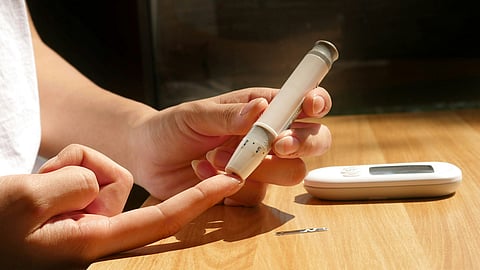
What followed was intense treatment. “He needs insulin for his entire life,” the couple says. Ihsan, now in Class 6, lives with an insulin pump that helps manage his blood sugar levels.
Subsequently, Bushra and Shihab started a Type 1 Diabetes Foundation in 2017 to seek government support for those affected by the condition.
Ihsan’s case is not rare. Eleven years ago, Abdul Jaleel and Fasna’s four-year-old son
Althaf was diagnosed with Type 1 diabetes. He had to take insulin injections three times a day.
“Those days, we were using normal injections. It was painful for him. He used to hide under the bed fearing the pain,” Jaleel recalls.
Later, online research led Jaleel to insulin pens. “They are more expensive, but at least we wouldn’t have to traumatise our son. So we switched,” he says. But the years weren’t smooth. Althaf suffered episodes of hyperglycemia and hypoglycemia at school if food and medicine timings differed even slightly. Any intense activity was a danger.
“He used to get seizures due to the issue, as it is not easy to detect when the sugar level goes high or low. We used to check at least seven times a day. Sometimes the levels fluctuate even while sleeping. Once he had a seizure in sleep,” Jaleel recalls. He adds that there is an element of anxiety every single day. “Initially, someone needed to be with him throughout, accompany him to school to give an injection,” he says.
The couple was later advised to opt for an insulin pump to manage the situation better. “Now he is 15, studying in Class 9. He needs insulin shots about six times a day,” he says.
Meeting other families in similar situations led Jaleel to create the Type 1 Diabetes Welfare Society. “We started it because treatment is lifelong and very expensive. Not every family can afford it,” he says.
Many children he knows are dealing with complications such as diabetic retinopathy and kidney problems requiring dialysis.
According to official data, at least 6,000 children in Kerala suffer from Type 1 diabetes.
What surprises Jaleel is the stigma. Many parents are reluctant to admit that their children have Type 1 diabetes. “This is more prevalent among parents of girls,” he says.

Project ‘Mittayi’
In 2018, the Kerala government set up Project Mittayi to provide free treatment and insulin to children under 18.
“But it came with a condition. The programme helped only families with an annual income of less than `2 lakh,” says Shihab. That meant many patients fell outside its ambit.
“It is not a practical cut-off. Type 1 diabetes treatment needs at least `20,000 a month. And then the project, which was under the health department, came under the Social Security Mission when the two departments were separated during the second Pinarayi government. That disrupted the support system.”
The parents say they have had to fight routinely for every right and concession, including seamless access to several schemes, including insurance coverage, open to children.
Another issue is that the insulin and parts of the pump are not available seamlessly every month, says Jaleel. Shihab points out that insulin wasn’t available for four months recently. “Parents were forced to buy expensive medicines from the market. Some even missed many doses, leading to more health issues,” he says.
In between, he adds, the analogue insulin available under the scheme was switched to a slow-acting one.
“While using the latter, children have to wait 30 to 45 minutes after the injection to have food. It is not practical in schools. We have been requesting analogue insulin for over a year,” Shihab says.
“Chief Minister V D Satheesan had promised us to make changes, including making the components and medicines available on time, making sure more and more people are brought into the ambit of Mittayi, and transferring the project back to the health department. But so far, none of this has been delivered.”
Then, there is another crucial question: what happens when the children grow up?
“After 18, how will we manage?” asks Shihab. He points to a new Union government scheme that provides free lifelong care under the Rashtriya Bal Swasthya Karyakram (RBSK 2.0) and the National Programme for Prevention and Control of Non-Communicable Diseases (NP-NCD).
“If the state government makes use of it, maybe the financial burden will be eased,” he says.
Expert speak
Calling for more awareness and government support, diabetologist Dr Jothydev Kesavadev says a patient with Type 1 diabetes loses approximately 42 healthy years of life in India, according to Breakthrough T1D Registry data.
He explains that insulin pumps are the best inventions so far for managing Type 1 diabetes.
“The current government has promised in the budget an indigenous insulin pump manufacturing plant in Kerala,” he notes.
“That will help bring down the cost. However, it is patented technology and involves delicate parts. Thus, the plan might take considerable time to materialise.”
Internal medicine specialist Dr Arun N M, meanwhile, calls for an extensive study on Type 1 diabetes incidence in Keralam. “Cases are on the rise globally too,he says. “However, we are yet to zero down on a trigger for this spike.”
Recommendations
Parents alone cannot follow international medical guidelines. It should be systematic.
Analogue insulin is required for the primary treatment of Type 1 diabetes. It necessitates at least four to eight injections per day.
An automated insulin delivery system — which integrates an insulin pump with a continuous glucose monitor — is essential for patients to lead a normal life and prevent related complications. The government should make this available to patients from low-income families. The proposed insulin pump manufacturer should try to adopt this.
Disability or special category
According to parents, Type 1 diabetes should be considered a disability or as a special category at the policy level, as it requires lifelong intense management and impacts daily life, even as an adult.
What is Type 1 diabetes?
A lifelong autoimmune disease that prevents the pancreas from making insulin. It was previously known as juvenile or insulin-dependent diabetes. It is also one of the most common chronic diseases that impact children. It can develop at any age, and the condition doesn’t have a cure.