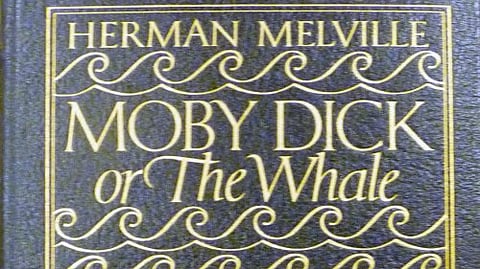

"Call me Ishmael.”
Just three words. Almost casual, they open one of literature’s most extraordinary voyages.
For 175 years, that hook from Herman Melville’s ‘Moby-Dick; or, The Whale’ has drawn readers into a world of restless seas and an all-consuming obsession with a white sperm whale.
Aboard the whaling ship ‘Pequod’, a hunt for a creature of the deep becomes an exploration of revenge, madness and humankind’s turbulent relationship with nature.
Published in 1851, ‘Moby-Dick’ follows Captain Ahab’s pursuit of the giant whale that once ripped his leg off. But the whale here is more than a quarry — it becomes the object of a maniacal obsession.
Herman is said to have drawn inspiration from the 1820 sinking of the American whaler ‘Essex’, which was attacked by a sperm whale in the Pacific. Accounts of the incident and its survivors, apparently, influenced him.
Despite its compelling premise, the book was not an immediate success. It was first published in London as ‘The Whale’ in October 1851, followed by the American edition, ‘Moby-Dick; or, The Whale’, a month later. Initial reviews were mixed, and sales weren’t impressive during the author’s lifetime.
Its long passages on whales, whaling, religion and philosophy made it a challenging read. The book’s reputation, however, grew in the early 20th century, when critics began to recognise the depth and ambition of Herman’s writing.
That depth still fascinates poet and translator Nithya Mariam John.

Moreover, she believes its core concepts remain relevant and relatable even today.
“The portrayal of Captain Ahab is a reflection of negative leadership, which is over-ambitious, authoritarian and solely focused on the self, while least bothered about ethics and humane values,” notes Nithya, who is an assistant professor of English at BCM College (Autonomous) in Kottayam.
“There is, in fact, an informal psychology term ‘Ahab Syndrome’ that’s used to suggest destructive obsession with a single goal or subject.”
One of Nithya’s strongest memories of the novel, however, is the whale (Moby Dick) itself. “I remember being captivated during my first reading. The battle scars and the grace with which the whale was described in the novel remain fresh in my mind,” she says.
Nithya believes the current times are ideal to revisit the book. “In an age when the world believes that we can conquer everything with the assistance of technology, the book is an important reminder that we need to emphasise the ‘human’ more,” she says.
Writer and former government employee Vineeth Abraham echoes that the theme is timeless. “It’s still relevant as it deals with obsession to the exclusion of all other emotions and how this can destroy a person and probably people around one,” he says.
Vineeth recalls being introduced to ‘Moby-Dick’ through an illustrated comic adaptation. “I read the original novel later. It was quite laborious, given its lengthy digressions. But patience did pay,” he smiles.
“However, considering the shortening attention spans these days, I would recommend the comic book for beginners. I still have my copy.”
Some, however, believe the beauty lies in the complexity. Like Abijit Radhakrishna, founder of the Bodhi Centre for Literary Studies.
“It moves between adventure, philosophy, humour, mythology, religion and even passages that read like a scientific investigation of whales. It is almost as if Melville was trying to capture the world in a single book and all of humanity in Ahab,” says Abijit, assistant professor of English at Sacred Heart College in Kochi.
The novel endures, he believes, because every generation discovers a different ‘Moby-Dick’. “We can read it as a story about human ambition, the limits of human knowledge, or the dangers of obsessive pursuits. And yet it doesn’t fit a single interpretation. Captain Ahab’s pursuit remains contemporary,” he adds.
Archana Gopinath, co-founder of The Reading Room in Thiruvananthapuram, cannot agree more. “It is a book I find myself referring to every now and then. I even use some of the opening lines while discussing with children how powerful ideas can be conveyed through simple words” she says.
“The book deals with weighty subjects such as human-nature conflict and ego, and that continues to resonate today. It reminds us that the world is not as black and white as Ahab sees it. Rather than asking what the whale represents, I am more interested in asking why Ahab saw things the way he did.”
The story ends in tragedy. Ahab’s pursuit destroys the ‘Pequod’ and kills all but one aboard. Ishmael, the sole survivor and narrator, escapes by clinging to a coffin floating in the sea.
The ‘white whale’ remains elusive, but has entered everyday language as an expression for an unachievable goal or a lifelong, unfinished ambition. It is perhaps a fitting nod to Herman Melville’s legacy.
The whale that inspired Moby-Dick
Before Herman Melville created his fictional white whale, sailors in the Pacific spoke of an albino sperm whale called Mocha Dick. Named after Mocha Island off the coast of Chile.
The beginning
The publishing history of Herman Melville’s Moby-Dick has an interesting twist. The novel first appeared in London on October 18, 1851, under the title The Whale, as a three-volume edition. The American edition, titled Moby-Dick; or, The Whale, followed on November 14.
The two editions were not identical. The London publisher, Richard Bentley, made several changes to the text, removing passages considered unsuitable for Victorian readers. The British edition left out the epilogue explaining how Ishmael survives the sinking of the Pequod. This left early British readers wondering how the narrator could have told the story.
The white whale and India
Moby-Dick has references to India. In the chapter titled ‘Of the Monstrous Pictures of Whales’, Melville refers to an ancient sculpture at the Elephanta Caves, describing it as one of the earliest representations of a whale. He also refers to the Matsya avatar of Vishnu.
Melville appears to have got his information wrong. Literary scholar Howard P Vincent, in his 1951 study The Trying-Out of Moby-Dick, traced the reference to Thomas Maurice’s Indian Antiquities. Vincent suggested that Melville had misread or conflated these descriptions, mistakenly placing the Matsya representation inside the Elephanta caves.
Moby-Dick’s many adaptations
One of the earliest film adaptations was the silent film The Sea Beast (1926), starring John Barrymore.
John Huston’s Moby-Dick (1956), featuring Gregory Peck as Captain Ahab, remains among the best-known versions.
Television adaptations include the 1998 miniseries starring Patrick Stewart and the 2011 version featuring William Hurt and Ethan Hawke.