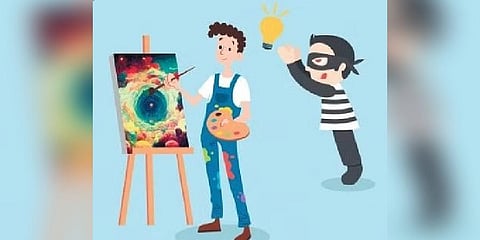

KOCHI: Copycats abound in every alley and bylane of our lives. We thrive on the easy access they provide us to things we could otherwise never afford in their original forms. Cheap versions of unpronounceable brands, China-made phones with logos intact, plagiarised love letters — we have them all. Art too succumbs, sometimes too blatant copying and other times, to subtle degrees of the same.
In art, there is but a fine line between absolute rip-offs and tiny tweaks that can pass as one’s own creation. Under Copyright laws, an artist has the exclusive rights to an original work; which means the right to decide how that work is used. The tricky part is Copyright protects only the artwork and not the idea.
Here’s a case that recently brought the issue of how much duplication can be legal, to the fore. In 1984, a magazine commissioned the famous American artist, Andy Warhol to create artworks using an original photograph of musician Prince, taken in 1981 by Lynn Goldsmith, after due credits were given to her for a single time usage. Warhol created 16 images out of which one was chosen.
After the artist’s death in 1987, the rights to these images went to the Andy Warhol Foundation. Years later in 2016, when the magazine used another from these images after paying the Foundation, Goldsmith was completely ignored. Litigation followed and it was concluded that Warhol did infringe on Goldsmith’s copyright.
Does that mean that all the Mona Lisa and Ravi Varma copies are criminal in nature? Certainly not, if one goes by the law.
Artwork is only protected for 70 years after the artist’s death. Many of them, like the above-mentioned, are in the public domain. So, you can twist Mona Lisa’s head, colour her cheeks blue and no one can drag you to court unless you are foolish enough to attempt it on the original that rests behind a bulletproof glass at the Louvre.
In India, however, copyright laws have never been seriously implemented. Artworks are copied with impunity. Proactive measures to safeguard one’s creativity are hardly in place and artists are mostly ignorant or unassertive of their rights.
The consolation is that ultimately what matters is originality. Packaging another’s idea with one’s own resources may seem the easiest way to proclaim artistic skills, but it will fail the test of time, for how can a splendid vision ever be copied in its truest form?