
Place names often carry stories that have travelled across generations, shaped by language, memory and local history. Chathamattom, a village in Ernakulam district, is one such place.
While the locality has undergone sweeping social and agricultural transformations over the centuries, the origin of its name remains open to interpretation.
Residents, historians and local researchers offer differing explanations, each rooted in a distinct chapter of the village’s past. Though no single theory has been conclusively established, together they offer a glimpse into Chathamattom’s layered history.
The first assumption many make is that the name has some connection with the folk deity ‘Chathan’. But that’s not the case.
One of the most widely cited explanations traces the name to Shradhamattam. According to Chathamattom native and historian Prof. T M Mani, whose views are recorded by writer and retired professor K P Thomas in Smarikkan Namikkan, the village was once known for its agricultural abundance.
Local accounts describe it as a prosperous settlement that remained productive even during difficult periods, including the World War I period. Its plentiful harvests allowed residents to host lavish community feasts. That drew sarcastic comparisons with the elaborate meals served after ‘shraddham (remembrance)’ rituals.
“Over time, it is believed, Shradha-mattam gradually evolved into Chathamattom in everyday speech,” says Thomas.
Another interpretation links the village to the worship of ‘Shastha’, another name for Lord Ayyappa. Retired teacher Paul V P points to the remains of an old temple site near the riverbank at Pullattumadathumpadi and the area’s long association with Ayyappa worship.
According to this theory, the settlement was originally known as ‘Shasthamattom’ — the abode of Shastha — before centuries of linguistic change transformed the name into Chathamattom.
“Ayyappa worship continues to occupy an important place in local religious life, with observances such as Makaravilakku still drawing devotees,” notes Dr Manesh N A, an associate professor of commerce from the area.
Supporters of this interpretation argue that the village’s name is rooted in religious tradition rather than any association with Chathan or supernatural folklore.
P Prakash, history researcher and president of Changampuzha Cultural Centre, notes that the transformation of the prefix ‘Shastha’ into ‘Chatha’ can be seen in several place names across Kerala. “That seems the most plausible explanation,” he says.
While the debate over the village’s name continues, Paul believes the area deserves deeper historical research. He points to local accounts of ancient metalworking.
“Slag-like remains have been found in the surrounding area, which some believe indicate early iron processing,” he says.
“Chathamattom may have contributed to weapon production during the Chera or Chola period, aided by its strategic location and river transport along the Muvattupuzha River — at least according to the village’s oral history.”
Beyond the debate over its name, Chathamattom is also associated with one of Kerala’s more unusual historical anecdotes: the discovery of a white elephant on May 24, 1813.
The unique pachyderm, it is said, fell into a pit dug by one Mullankatt Neelakandan during an elephant-catching expedition in the forested hills surrounding the village.
“The rare find is believed to have attracted the attention of the Travancore administration and coincided with the birth year of Maharaja Swathi Thirunal Rama Varma, leading many to regard it as an auspicious event,” says Thomas.
“The episode has endured in local memory through records and commemorative inscriptions. Residents also refer to what is believed to be a copy of a letter in which Rani Gowri Lakshmi Bayi informed Colonel Thomas Munro, the British Resident in Travancore, about the discovery.”
The original document is believed to be preserved in archival records in Thiruvananthapuram.
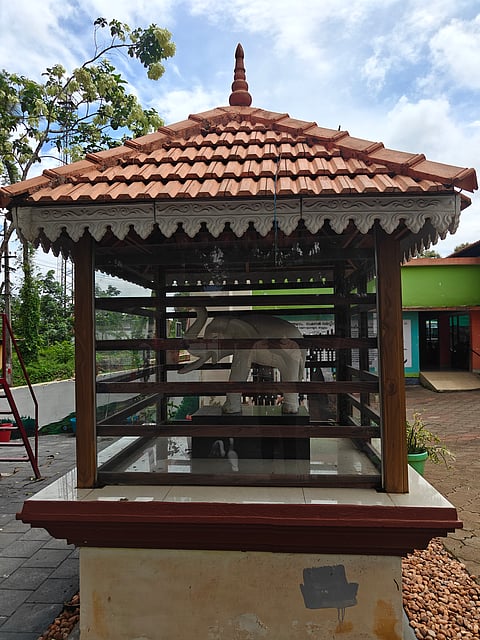
In 2013, the village marked the bicentenary of the event by installing a white elephant scuplture at Government Higher Secondary School, Chathamattom.
“The discovery of the white elephant remains one of the most significant events in the village’s history,” says Thomas.
This story was reported by Akshay Babu for TNIE Kerala.
