
"It seemed as if all the blue lagoons of the southern seas had come to rest in the wide bosom of Mother India at Cochin.”
These were the words penned by Robert Bristow in his autobiography ‘Cochin Saga’ (1959), as he recalled his first impression of this maritime city.
Shortly after his arrival in April 1920, the stillness and calm of this historic town gave way to the industrious vision of the harbour engineer. What followed was a decade-long effort to build a modern port in Kochi.
It was no easy feat. The main challenge was a rock-like sand bar guarding the entrance to the naturally formed Kochi port.
The port itself dates back centuries, formed after the great deluge of 1341. From 1795, it came under British rule. Yet, despite its long history, it posed a major limitation.
“The issue was that large steel vessels couldn’t enter the port due to the sand bar,” notes artist and historian Bony Thomas.
“To unload the goods and carry it back, people then used country boats, an elaborate and tiresome process.”
Bristow’s idea was to reclaim land within the backwaters. This vision not only enabled the construction of a modern port but also led to the creation of the man-made wonder that we now know as Willingdon Island.
To achieve this, he needed a powerful dredger. An order was placed with the Scottish firm Wm Simons & Co Ltd, as noted in ‘A Queen’s Story: Five Centuries Of Cochin Port’ by former bureaucrat and writer D Babu Paul.
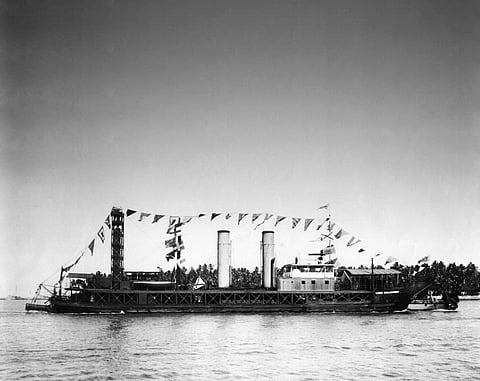
The dredger was named after the then-governor of Madras Presidency: 'Lord Willingdon'. This is the story of that vessel. One that worked tirelessly for Kochi port, and ultimately sank in its service.

Big muscle
The dredger was a magnificent machine, with a pipeline stretching 1,000 yards. “Formidable,” Bristow had noted.
According to Bony, the ‘Lord Willindon’ arrived in Kochi via the Red Sea in March 1926. “However, the dredger was damaged on this grand voyage. It had run aground in the Red Sea. As soon as it arrived, it had to be docked for repair work,” he says, citing old records.
Hence, the dredging work began only in May. And once on the job, it was relentless.
“Every day for over 20 hours, ‘Lord Willingdon’ was used to pump out the silt, deepen the Cochin harbour. The excavated mud was used to create Willingdon Island,” says Bony.
By March 1928, a deep channel — 11,000ft long, 400ft wide and 32ft deep below low water — had been dredged.
Bristow was ecstatic. The moment felt almost biblical to him. “When the dredger finished its last cut, sirens were blown, and flags hoisted to proclaim our victory,” he wrote in his autobiography.
“At this precise moment, the sun, which had been obscured by clouds all morning, suddenly shone through, and then, close round it, there appeared a firmly knit halo of the seven rainbow colours, vivid and brilliant…. Dramatic, symbolic, unique, prophetic? It was all of these to me, for I had never seen, or even heard of such an occurrence, and its appearance at that moment, of all others, reminded me of some of the Old Testament stories.”
The mission, however, was far from over. The next task was to enlarge the channel so that any vessel capable of passing through the Suez Canal could enter Cochin. This phase of work began on December 3, 1928. It was completed in just over three months, by March 13 the next year.
Through these efforts, ‘Lord Willingdon’ reclaimed about 3.2sq.km of land, forming Willingdon Island, which continues to house the Kochi port.
“The port was declared operational when the steamship SS Padma was granted clearance into the newly constructed inner harbour on May 26, 1928 — just days after the channel’s completion,” says a Cochin Port Authority official. “It was a coasting vessel of the Bombay Steam Navigation Co.”
Hazards on the way
If Bristow was the brain, ‘Lord Willingdon’ was the big muscle. Hundreds worked alongside. The work was gruelling — hauling slush out of treacherous waters for 20 hours a day.
Besides damage from the initial voyage to Kochi, the dredger faced challenges such as Kerala’s unpredictable weather and the limitations of a rookie crew.
“In May 1927, it faced an accident. There was a fire,” says the port official. “The blaze, however, was contained by an engineer on board. Thereafter, Bristow ensured that the crew received proper training before resuming work.”
Difficulties persisted. On its first day at sea after repairs, a heavy gale damaged the dredger’s pipeline. “Bristow found that the ball joints and pontoon connections had to be redesigned to suit local conditions,” Babu Paul notes in ‘A Queen’s Story’.
Bristow rushed to Scotland to procure the parts needed for modifying the dredger. In his absence, the dredger continued work within the calmer waters off the harbour. On his return, ‘Lord Willingdon’ ventured back into the sea, now better equipped and more resilient.
By the end of 1928, Kochi had a three-mile-long channel, 450ft wide and 35ft deep at low tide.
“Finally,” wrote Bristow, “the ‘Lord Willingdon’ came into harbour flying every flag on board, having beaten all records for work in the open sea for continuity of pumping, output, and lowness of cost….”
The end
The dredger continued to be in service well after India attained Independence, before sinking in 1978. Not many details are available about the incident.
“It was said that the dredger was at work in the sea when it sank. There are no records of any human loss,” says Bony.
Today, four anchors salvaged by the Indian Navy remain ashore as a reminder of the historic vessel that played a crucial role in shaping Kochi.
These have been installed near the Port Museum on Willingdon Island, near Fort Kochi beach, at the Merchant Navy Club, and on the premises of the Indian Navy Maritime Museum.
One can spot one of these anchors on a walk along the picturesque Fort Kochi beach. Resting quietly while overlooking the Chinese fishing nets and the deep channel it once helped create.
Companion
‘Lord Willingdon’ was later joined by a companion — a bucket dredger named ‘Lady Willingdon’, which arrived in 1937. The two worked together for years, continuing their service even after India gained Independence.