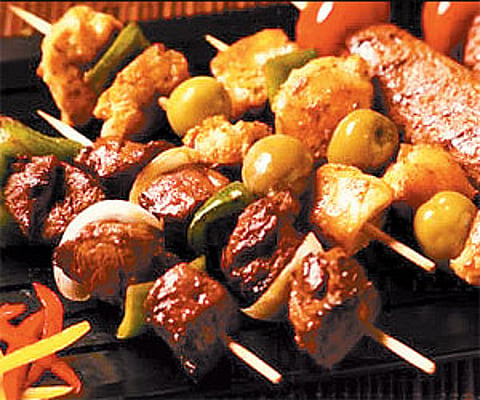

There are many references as to how the word Kebab was derived? It may have been derived from the Arabic word “Kab” which means a turning moment and “Cabob”, meaning piece of meat, fish, lamb or vegetable. So the fusion of these two words lead to kebab. The Arabic word could also possibly be derived from Aramaic, kabbābā, which probably has its origins in kabābu, meaning “to burn, char”. The Persian term kabābwas was adopted by medieval Arabs and Turks as kebab. It is also defined to be synonymous with tabahajah, a Persian word for a dish of fried meat pieces. Kebab was used frequently in Persian books of that time to refer to meatballs made of ground or pounded chicken or lamb.
In the modern period, kebab gained its current meaning of shish kebab, whereas earlier shiwā had been the Arabic word for grilled meat. Kebab still retains its original meaning in the names for stew-like dishes such as tas kabob (bowl kebab). Similarly, kebab halla is an Egyptian dish of stewed beef and onions.
The origin of kebab may lie in the short supply of cooking fuel in the near East which made cooking of large foods difficult, while urban economies made it easy to obtain small cuts of meat at a butcher’s shop. The phrase is essentially Persian in origin, and Arabic tradition has it that the dish was invented by medieval Turkish soldiers who used their swords to grill meat over open-field fires. In India, Ibn Batuta records that kebab was served in the royal houses since at least the Sultanate period, and even commoners would enjoy it for breakfast with naan. The dish has been native to the near East and ancient Greece since antiquity; an early variant of kebab (Ancient Greece: obeliskos) is attested in Greece since 8th century BCE (archaic in Homer’s lliad and Odyssey) and in classical Greece in the works of Aristophanes, Xenophon and Aristotle among others. The kebabs also form an important part of Azerbaijan, Armenian, Afghan, Arabic, Turkish, Kurdish, Iranian, Iraqi, Pakistani , Indian, central Asian, south Asian and some of the African cuisines.
In India, we usually associate kebabs with the advent of mughals from central Asia, only because it was the Mughals who popularised it. Rajputs, for example, made Sule or smoked kebabs long before Mughal invasion.
As hunting was a popular sport of the maharajas, game meat was cooked over an open fire in forests. The meat was not consumed the same day but pickled to preserve for the next day.
The origin of kebab was probably just a hunk of freshly killed animal meat, smoked or cooked over wooden fire with little salt, and may be with some chilli powder added to it. The subtle addition of flavours, textures and tastes was an art form that evolved over a period of time.
In India, the tandoor was introduced from central Asia, which was used for baking breads such as naan, roti, layered bread called parantha and others.
The tandoor is a clay oven which was installed in the village centre and was called “sanjha choolha” where village women would collect in the evening with their doughs to bake the bread.
It was Kundan Lal Gujral who turned this plebian village tandoor into royal form of baking in restaurants by inventing the tandoori chicken and creating history, or should I say creating a cuisine, called “the tandoori”. In other parts of north like Kashmir, Kashmiri Muslim cuisine revolves around lamb meat, characterised by its use of delicate flavours such as cardamom, saffron, yoghurt and aniseeds. Kashmiri Tabak Maaz, a kebab made of tender rib of lamb, is a gourmet delight.
Rajasthan is also known for its kebabs, especially Palanpur where the Nawabs were of Afghan descent who introduced kebabs and pullaos.
Not to forget, Hyderabad which is equally known for its fiery food made by mixing fiery spices from Andhra Pradesh and large chunks of meat kebabs unlike the Awadhi kebabs such as Gilawat ke kebab, kakori and Shikumpur kebab which are so delicate that they melt in one’s mouth.
The Moghuls brought with them their culture and cuisine. Ingredients which were unknown in India such as dryfuits, fragrances like rose water, kewra were brought from Turkey and Afghanistan and were used to form a fusion with local foods. The culinary art of Awadh (Lucknow) was raised to fine art under the royal patronage, where various cooking methods were born. For instance, royal chefs invented methods like Zamin Doz, which imparts an earthy flavour to kebabs and cooked food; Dum Pukht, where the food is cooked under pressure (dum) so that it retains the aromas of the spices used.
The kebabs have trailed all over the globe, being invented and reinvented in shape, size, texture and even cooking style depending on climatic conditions, geographical features, customs and cultures. Doner kebabs from Turkey, tandoori kebabs from India, Chapli kebabs and Boti kebabs from Pakistan and Afghanistan, testi kebabs from Black Sea region and Chellow kebabs from Iran are famous all over the world.
The writer is a well-known restauranter and author of many cookbooks