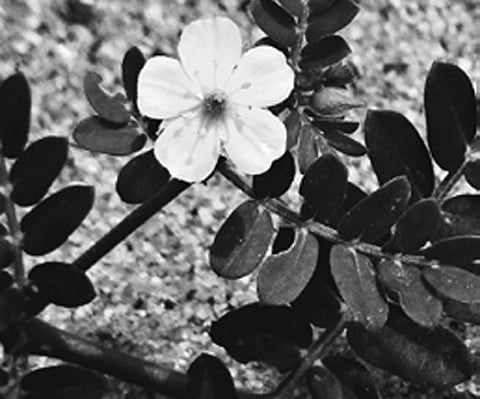

A beautiful carpet of small yellow flowers beckons you. If by chance you step on it barefoot, you are in for an unpleasant surprise as you have stepped on a carpet of three-angled thorns with six spikes of the Tribulus terrestris plants.
When I worked as Sub Collector in Chidambaram, Tamil Nadu, during my visit to interior villages, I had seen many women harvesting these thorns, drying them and selling them for a pittance.
They would tell me that vyaparis were interested in buying it and that they had no real knowledge of its properties. The price has now shot up to Rs 200 per kg in the local ‘Nattu Marunthu Kadai’—the traditional apothecary stocking these herbs, probably because of greater demand and perhaps because the women harvesting it have better employment now.
If you are planning on using it, buy only about 100 or 200 gms, as one kilogram is a lot of thorns! Nerunjil Mullu (as it is called in Tamil and Gokshura in Sanskrit) constitutes one of the five lesser herbs of the Dasamoola group; the other four being Solanum indicum (mullankathiri in Tamil), Solanum virginianum (kantankatri in Tamil), Desmodium gangetica (orillai) and Pseudarthria viscida (movillai).
The thorn (botanically, a fruit) has diuretic action and is, therefore, very useful in treating kidney stones, difficult micturition i.e. urination, chronic cystitis, and other genito-urinary disorders. As a first line of treatment, when you have a burning sensation during urination, this herb is extremely helpful.
Take a small handful of the dried thorns, add about two glasses of water.
Boil down to half a glass. Remove the thorns and drink the water.
You should consult a vaidyar, if the problem persists.
Nadkarni (1954) and Kolammal (1978) have also documented the use of this drug in tackling impotence, diabetes, piles and rheumatism. The herb has been in the news because it is said to increase testosterone levels in males, though it has not been conclusively proved. It is being popularised in the West as a cure for infertility, erectile dysfunction and low libido and to improve sports performance, though its scientific basis is not well documented.
However, Ayurveda, Unani and Chinese medicine use this herb for treatment of disorders of the genito-urinary tract. In Ayurveda, this herb enters into the composition of the classical formulation Vastyamayantaka ghrtam.
Of course, this is only one of the more than 50 herbs that make up that ghrtam or medicated ghee.
This ghee is used widely in the treatment of urinary tract problems. Snehabanam with this ghee is done as part of an advanced treatment for urinary tract problems, including prostate problems where almost 300 ml of ghee is administered to the patient under the direct supervision of the vaidyar with strict dietary regulations.
Large quantities of medicated ghees are administered only after taking into account the digestive capacity of the patient and other health parameters.
Medicated ghees are very useful in treating health problems because ghee is a great vehicle or anupanam wherein the ghee absorbs the properties of the herbs and is able to take it to the various tissues of the body, thereby directly tackling problems at the tissue level itself.
I have not found any of the other dasamoolam plants in Chennai, so maybe my next article can be on the dasapushpam, the 10 sacred flowers of ayurveda, many of which I see growing wild in the city.
The writer was earlier Health Secretary, Tamil Nadu and is currently, Principal Secretary and CMD, Tamil Nadu Handicrafts Development Corporation. She can be reached at Sheelarani.arogyamantra@gmail.com.
Earlier articles can be accessed at www.arogyamantra.blogspot.com
