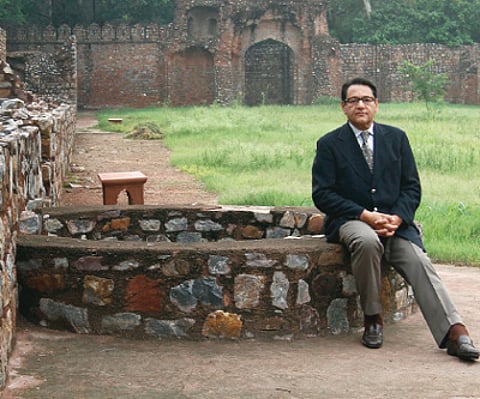

He’s been there, done that. And Rakesh Mathur, the CEO of WelcomHeritage, a joint venture between ITC Ltd and the Maharaja of Jodhpur’s Marudhar Hotels, left the cheerful opulence and jet-setting lifestyle to start out on a path less glamorous but incredibly fulfilling. “Away from the glitzy world of starred and branded city hotels, lay the richness of our civilisation and our historical evolution. The different cultures, cuisines, art, handicrafts, traditions, religions and languages are woven into the grand India experience,” he says.
Born into a family of administrators and educationists in Rajasthan, Mathur grew up in the lap of beauty and serenity in Shimla. There he went to St. Edward School, and then graduated from Shri Ram College of Commerce, Delhi University. His management training started with the Oberoi Hotel in 1973.
Having worked with many top hotel chains all over the world, Mathur was pleasantly surprised when the opportunity of promoting heritage hotels came his way in 2001. “I was suddenly exposed to a different world. One that I never knew existed. I realised that apart from business tourism, the story of India lay in experiencing its diversity which couldn’t be replicated anywhere in the world,” he gushes with enthusiasm.
It didn’t take long for Mathur to learn and appreciate the abundance of the country and since then he has worked relentlessly to promote heritage properties. “During my many travels, I grew to love and be proud of our heritage, both natural and man-made, and realised that the very essence of tourism in India was about heritage tourism and nothing else,” he affirms.
And here we are not just talking about a couple of properties. On offer are 60 exclusive heritage destinations. You can book a holiday to adventure filled jungle-lodges, tea garden homes or to quiet and quaint nature resorts in almost all the states. “Each property has been converted from palaces, forts, havelis, traditional homes, plantation estates, etc and they have their untold stories,” says Mathur who believes that the overall feel of the place is crucial for it to be a success. The fact that all of the heritage properties have been residences of people earlier, make them even more charming and rustic. “They haven’t been designed as hotels. They reflect the essence of the cultural and architectural style, as well as the lifestyle of that period and place which cannot be replicated in modern luxury hotels. For that reason, everything appears more personalised rather than standardised,” he says.
Steeped in history, these properties are exclusive yet affordable. The accommodation combines a slice of heritage with modern amenities; a local flavour in the cuisine, the craft and the cultural vignettes. “A lot of efforts have gone into converting these properties into hotels and providing comforts required by the modern customer. And I would say we are doing pretty good,” says Mathur with a smile.
But there is one property that caught Mathur’s fantasy. “The Bal Samand Lake Palace and Garden Retreat at Jodhpur is awe-inspiring. The building of a huge dam, creating a lake on one side and a beautiful garden on the other, is truly a marvel of its time. The waters, the rocky hills on all sides, the plants and the birds make it a scene right out of the books,” says Mathur whose favourites are the garden rooms amidst the flowers, trees and birds that blend in perfect harmony to create a fascinating experience.
And it’s not just about the incredible locales and adventures. Restoration of these sites are crucial. “We encourage owners of these properties to convert them into productive assets, and assist them by providing technical expertise, marketing, sales, reservation and operations support services. Through other initiatives, we help in the preservation of our environment, while also promoting our rich culture, handicrafts and cuisines,” he says.
So this summer there are a few sites that have become the favourites of avid visitors to these properties. “They are mostly headed towards the hills this time of the year. Fortunately, we are well represented in Nainital, Shimla, Ooty, Gangtok, Darjeeling, Mussoorie, Kangra, Dharamshala, Kashmir, Ladakh, Mount Abu, Ramgarh, Ranikhet, etc. They are all unique properties each offering its own locational experience,” he says.
Mathur is a man who practices what he preaches. His house
overlooks the back entrance to the monument, Arab Ki Sarai, where he goes for his morning walks whenever in Delhi.
Having been awarded the Karmaveer Chakra by the Indian Confederation of NGOs, Mathur believes that the tourism industry gives the country so much and one must pay back and ensure its long term sustainability. “We expect the Indian government to support us in practicing responsible tourism. As the founder Vice President of Ecotourism Society of India, I will support the synergy of policies, initiatives and activities at the national and state level,” he says.
Today WelcomHeritage is the largest chain of heritage hotels and resorts in India. According to Mathur, it will be their endeavour over the next few years to maintain this leading position. “The company is also considering international growth in south Asian countries.”
The little things in life matter a great deal to Mathur—chatting with a local, savouring some local cuisine, shopping for some local handicrafts is what make the experience unforgettable. And he smiles: “That is the real heritage experience.”
