
Uganda doesn’t immediately set the tourist blood flowing. Minus the abundant wildlife, Lake Victoria and the Equator, the only attraction in this landlocked East African country are the Kasubi Tombs, the oldest proof of the nation’s history.
About 20 minutes (or five km) away from Kampala’s city centre is the protected burial site of the Kabakas, the kings of Buganda, a sub-national kingdom which enjoys autonomy from the State. For those interested in Uganda’s history, this is a great place to start, though it won’t seem so much a ‘tomb’ as a ‘living museum’ once you walk through the Bujjubukula (gatehouse made of wooden columns and thatch) and into the Olugya (the courtyard) of the complex.
Within the site, women are expected to cover up waist down (no shorts or pants allowed. Long skirts are perfect) as respect to the dead. They are also not allowed to venture into the Drum House, no matter how tempting the drums or how empty the huts. The Ndoga-Obukaba (Royal Drums) contained within the house are played only when a Kabaka is crowned; when a member of the royal family arrives or departs; or when a family member dies. More intriguingly, the drummer has to lead a life of strict celibacy — that should answer any questions you may have about the ‘female boycott’ in the Drum House.
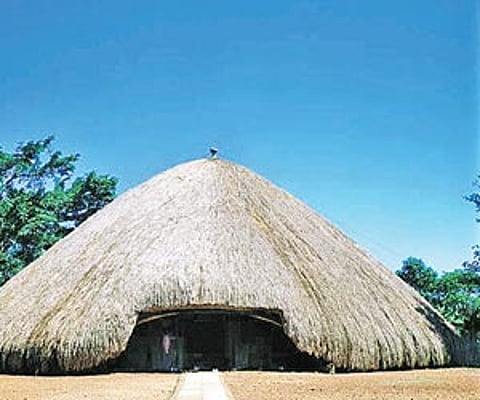
Another interesting sight is, or would have been, the Muzibu Azaala Mpanga — a domelike structure in the centre — where four former Kabakas (Muteesa I: 1835-1884, Basamula Mwanga II: 1867-1903, Daudi Chwa II: 1896-1939 and Fredrick Walugembe Muteesa II: 1924-1969) are buried. Today, you can see the main tomb only in pictures on the reception walls; two years ago, a fire destroyed this complex which is now being rebuilt. Made of organic materials such as wood and reed and with a thatched roof that extend all the way to the ground, the walls of the gigantic tomb are covered with shields, medals, spears, drums and photographs of Kabakas.
The site also houses a few scattered buildings and graveyards located behind the tombs. These buildings house the descendants of the kings’ wives — the keepers of royal secrets. The ‘royal’ women tend to their vegetables — cassava, yam or eggplants — when they’re not entertaining visitors. The graveyards behind the tombs are heavily guarded. There are no body-checks but it’s best to avoid carrying anything that may lead to suspicion, even match boxes or lighters. The fire that burned down the royal tombs has left everyone scarred.
The site made it to the Unesco World Heritage List in 2001 and it’s easy to be awed by the circular, thatched roofs and reed walls (not to mention the richly coloured paintings on barkcloths) — a reflection of the Buganda’s commitment to the environment, culture and traditions.
When visiting here it is good to remember that to the Baganda (people of Buganda), the Kabaka is the unquestioned symbol of the spiritual, political, and social state of the Buganda nation. So even if you are tempted to say or do something out of place, don’t. The rituals and traditions here are centuries old and sacred.
anjalytn@gmail.com