
A peculiar malaise underlines the overtly rationalised routines we call everyday. A restless mind wanders sometimes to verge upon the unknown, sometimes to better experience the known. Either way, it is release that is sought. There are times in history when mankind pushes to the margins its fear of loss, it is then that risk-taking becomes a cultural ideal and risk takers icons of tomorrow. Some measure their maiden moon missions in small steps, others scale the earth’s greatest height because it’s there. Their great adventures, in all their anecdotal simplicities, are then narrated, illustrated, celebrated, till that thing called eternity.
An adventure is an unconditional sense of the present, no fear of the past, no desire for a future. And, what better way to embrace the present than on a fine piece of watchmaking. Historic expeditions have changed how we look at life but the timepieces that assisted these expeditions, lending accuracy and precision at the turn of every second, have remained all the same. Journeys are over, heroes have aged, but the watches continue to remind us of a time they have witnessed and of a time that will be; ticking away, just ticking away.
OMEGA
“There’s a historical milestone in the fact that our Apollo 11 landing on the moon took place a mere 66 years after the Wright Brothers’ first flight.” - Buzz Aldrin
Is there anything more ecstatic than a bunch of men bouncing off the surface of the moon, better still, getting a grip on that distant celestial body that tides over our love signs, our sacred days, even our mood swings? When Buzz Aldrin, lunar module pilot of the first manned moon mission, chose to wear an Omega Speedmaster Professional to work that day, the Swiss horologer was immediately embedded in human history’s most euphoric spectacle. The Speedmaster; that was hence nicknamed The Moonwatch. It had a black dial and luminous hands for clear reading, a tachometer scale that showed upto 7000 RPM and a water-resistant case if he happened to spill coffee, quite likely in his zero-gravity workspace. Making it an instrument watch, there was a screw-in back, a domed crystal and an additional inner cover that protected the movement. The dial markings were characteristic of the brand’s Speedmaster series, with minute and hour chronograph counters that were complemented by a third sub-dial for the small seconds. A mark of precision was the central chronograph seconds hand that was activated and stopped by the top pusher on the side of the watch and could be reset with the bottom one. The model launched in 1937 was powered by a calibre 321 movement. In 1968, this model was succeeded by the enhanced calibre 861. Other than few technical refinements, the chronograph remains essentially unchanged. As watch fanatics see it, the moon mission was about an Omega and everything else rocket science.
ZENITH

“As a little kid, I climbed a lot of trees because I always loved the bird’s-eye view.”-
Felix Baumgartner
Adventure, much like technology, outgrows itself relentlessly, making the past look silly and the future predictably unpredictable. Jumping off a death cliff was taken seriously until October 14, 2012, when Austrian skydiver Felix Baumgartner launched himself into the stratosphere from a space capsule suspended from a helium-filled balloon to embark on a 128 km supersonic freefall. Strapped on tight was Zenith’s El Primero Stratos Flyback Striking 10th Chronograph, making it the first watch to break the sound barrier in a near space environment. The watch runs on Zenith’s patented Caliber 4057 B; nicknamed El Primero; which beats at a super-quick frequency of 36,000 vph. The center-mounted chronograph hand makes a complete revolution around the dial in 10 seconds rather than the usual 60. It records elapsed time to a precise 1/10th of a second.
ROLEX
“Nobody climbs mountains for scientific reasons. Science is used to raise money for the expeditions, but you really climb for the hell of it.” - Edmund Hillary
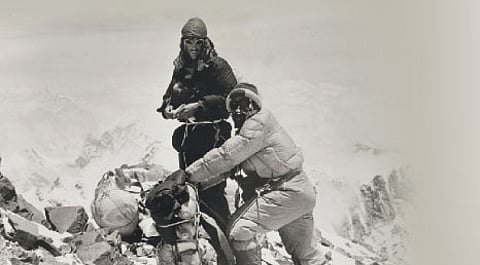
A strong hurricane-like wind throws him back, over and over again, a blanket of fog blinds him from a cliff that is silently waiting to be discovered. What’s that cavity there? It could be a harmless crevice or a deathly crack and the only way to find out is to stomp over it. On May 1953, Edmund Hillary only cared for one thing: to touch the peak of Everest. And, every time he brushed snow dust off the dial of his Rolex Oyster Perpetual, he knew he was a little more closer to it. The brand was one of the sponsors of the expedition and part of this sponsorship included providing Hillary with this watch. Produced in 1950, it wasn’t a gift and was to be returned to Rolex after the descent. In fact, the brand needed it for extensive testing to understand what it endured during the experience. It now rests in the Beyer Watch and Clock Museum in Zürich, next to a fragment of postal packaging from Hillary’s home country New Zealand. The creamy dial has faint burns from the radium in the hands. The dagger hands, triangular indexes with inlayed Radium, and small applied coronet at 12 o’clock are symbolic of a vintage classic. The word ‘Officially’ in the scribbling ‘Officially Certified Chronometer’ is still a nice bright red colour, the other letters have faded. The minutes track though, like in any novel piece of watchmaking, is in mint condition.
TAG HEUER
“It was quite a day. I don’t know what you can say about a day when you see four beautiful sunsets” - John Glenn
Over 27 million Russians died fighting the Nazis, the Sovietpolitical and cultural infrastructure, tethered and torn, was hoping against hope. Yet, a little less than two decades after, they unleashed a man onto space. The April of 1961 saw Soviet cosmonaut Yuri Gagarin resurrect the spirit of a nation, a one-up in its space-war against the other superpower. As expected, the arch rival in question responded the following year. American astronaut John Glenn became the second man in space after piloting the Friendship 7 in February 1962. No one celebrates seconds with the same vigour, but for the Swiss watchmaking industry, this was a first. The first ever Swiss watch—Tag Heuer’s Carrera SpaceX 1887 —had reached space. The Heuer 2915A was modestly oversized by wristwatch standards for a clear and legible display. The watch could be manually wound via the crown on top of the case; it measured seconds on the outer dial, elapsed minutes on the 12 o’clock sub-dial and elapsed hours on the 6 o’clock sub-dial. To make it fit over the spacesuit, elastic bands were attached to it. In 2012, the brand marked the 50th anniversary of TAG’s space travel with the limited ediion Carrera Calibre 1887 SpaceX.