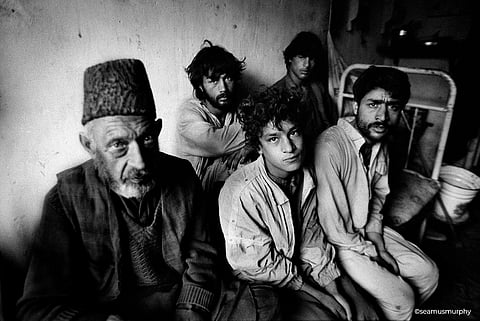

“Every life is in many days, day after day,” author James Joyce writes in Ulysses. The line is a fitting title for the work of photographer Seamus Murphy, who has spent over four decades documenting everyday lives across the world. Murphy’s photographs are now on view for the first time in India at the Life is in Many Days exhibition hosted by Museo Camera in Gurugram.
The seven-time World Press Photo award recipient has photographed places shaped by conflict, political change and social upheaval, including India, Afghanistan, Gaza, Lebanon, Sierra Leone and Ireland. What has been constant is his focus on people, their relationships and the moments that reveal something about their lives. “I do photograph people a lot. I like landscapes, but I like people more,” he says. The exhibition is curated by Zelda Cheatle.

Faces of the conflict
Afghanistan occupies a significant place in his career. Murphy first travelled to the country in 1994, at a time when, “there was no interest” in it, he says. His documentation of the different periods of conflict resulted in three books — A Darkness Visible: Afghanistan (2008), I Am the Beggar of the World (2014) and The Hollow of the Hand (2015), the latter made in collaboration with poet and musician PJ Harvey.
A 2000 photograph from Takhar province shows a woman in a white burqa holding a child, while another from 2002 Kabul shows a woman in a leather jacket partially covering her face with a torn photograph of a woman confiscated by the Taliban. Alongside are photographs of everyday life, from workers to horsemen and those engaged in Kaftar Bazi, the sport of pigeon flying.
His Afghan photographs also go into intimate spaces; they juxtapose individual histories with the nation’s history. In 1994, he stayed with the Ba Deli family in Kabul’s Shor Bazaar; a family he has photographed for three decades. Several of its members were killed in the war, while others were forced into exile. One of them, whom Murphy photographed as a teenager, died recently at 47, while other family members live in Turkey and Germany, following the return of the Taliban in 2021.
Looking at the original photograph of the family today, he says, is like “looking at an old family picture” and remembering everything that happened afterwards. “The series of photographs of the family shows the tragedy that they’ve been through, but also the joy they’ve been through.”
For Murphy, this long-term relationship distinguishes his work from simply documenting a news event. “You get to know people, you get to know the place, you get to know the politics,” he says. “That feeds your photography and the images.”
An insider, an outsider
Murphy grew up in Ireland during the late 1960s and early 1970s, when the troubles in Northern Ireland began. He left in 1983 and has been based in London since 1987.
His return to photograph Ireland became the 2016 book The Republic. When he went back, the Ireland he knew had changed significantly. By the time he completed the work, the country had undergone major social changes, such as the legalisation of same-sex marriage through a referendum.
Murphy wanted to photograph both what remained of the Ireland he remembered and what was changing. Among the photographs is one of women jumping into Dublin’s Sandycove Forty Foot, a spot made famous by Joyce’s Ulysses that was exclusively male until women protested in 1974.
“I don’t think I could have done that work had I not been away and spent all that time away,” he says. “Sometimes it’s great to be an insider, but sometimes being an outsider helps you see things in a more interesting, more translatable way, in a way that communicates better.”
While Afghanistan established Murphy as a photojournalist, America brought him back to being an amateur, he says, referring to the photographer he had been in his twenties in San Francisco, guided by instinct and curiosity. He returned to the US in the early 2000s to photograph American life. Later in 2017, while photographing Russia, he began noticing similarities between ordinary life there and in America, particularly among working-class communities.
The twin journeys produced Strange Love, a project of 88 photographs made over more than a decade—44 from Russia and 44 from America—deliberately sequenced Russia, America, Russia, America, to make the viewer lose track of where they are.
“Are our lives that different in each place?” he asks, questioning the political and national divisions through which people are taught to understand one another.
A city beyond its postcard
Now working in India, he says that watching people share space and food on a train in Kolkata reminded him of similar experiences in Russia. “Why do leaders always tell us how different we are? Actually, we’re more similar than we are different.”
His interest in ordinary lives informs Murphy’s current work in Kolkata, where he spends part of the year. His wife grew up in Kolkata, and he was drawn to its people, street life, history and architecture, including its Art Deco buildings. But photographing an Indian city that has been extensively photographed has its challenges. Murphy did not want to reproduce familiar images of its river, colonial architecture, poverty or decaying buildings. “It’s far more important to me to reveal what life is like for people living here,” he says. At the same time, he was conscious of his position as an outsider. Kolkata images at the exhibition include workers at a leather tannery, a person working under a bus and young boys playing football on the street.
After more than three decades of photography, Murphy remains driven by the pursuit of images that say something beyond the moment in which they are made. Sometimes he walks for days without taking a photograph. At other times, everything aligns in a single frame—the light, mood, composition and gesture. “It’s finding that moment or composition that just speaks to me,” he says, and that search is reason enough to keep walking.