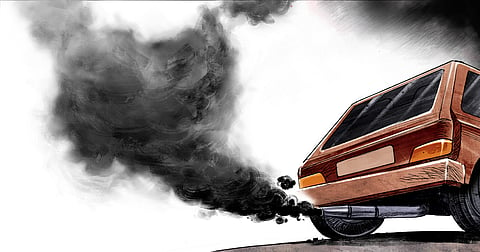

In 2024, heavy-duty vehicles (HDVs) are estimated to have contributed 79 per cent of nitrogen oxide (NOx) emission and 64 per cent of particulate matter of 2.5 microns (PM2.5) along with other harmful pollutants such as black carbon, carbon dioxide and carbon monoxide from their tailpipes.
This level of pollution caused by road transport was responsible for an estimated 90,000 premature deaths and 15,300 new cases of paediatric asthma in India in 2024, according to a report prepared by the International Council on Clean Transportation (ICCT). These estimates included premature deaths resulting from ambient PM2.5, ozone (O3) and nitrogen dioxide (NO2), as well as new asthma cases associated with NO2.
The report titled ‘Health Benefits of Zero-Emission Transport through 2050’ evaluated the health impacts of air pollution from road transport and emphasized the advantages of transitioning to electric vehicles. It also noted that while HDVs represent a small share of the global fleet, they disproportionately contribute to air pollution. India’s air pollution is significantly impacted by HDVs despite these vehicles making up less than 4% of the country’s total fleet.
They are a major source of nitrogen oxides which are linked to premature deaths, as well as PM2.5 that can cause asthma. Light-duty vehicles and two and three-wheelers predominantly emit volatile organic compounds and carbon monoxide.
In 2024, health impacts from road transport pollution were estimated to have resulted in 700,000 premature deaths and 250,000 new cases of paediatric asthma globally. Nations with middle and low incomes bear a greater burden from these health impacts, while only high-income countries are seeing a declining trend due to current policies. The report highlighted that the electrification of HDVs would enhance air quality in India.
Unequal burden on Delhi-NCR
It flagged that Delhi and the National Capital Region (NCR) bore an unequal burden of HDV pollution. In highly polluted areas of the NCR, road transport alone exceeded the World Health Organization’s (WHO) annual NO₂ guideline of 10 µg/m³ for all sources combined. In Delhi, exposure to PM2.5 attributable to road transport reached 13 µg/m³ in 2024. It was more than 2.5 times the WHO guideline for total PM2.5 from all sources.
Consequently, the NCR accounted for 23% of the country’s road transport-related paediatric asthma cases and 9% of premature deaths even though it represented only around 5% of the nation’s population.
In Delhi NCT, the percentages were 3% for premature deaths and 10% for asthma cases, despite its small share of the country’s population at just 1.2%.
Another recent report by the Air Pollution Action Group (A-PAG), in collaboration with the Indian Institute of Technology Delhi (IIT Delhi) and The Energy and Resources Institute (TERI), shed light on the contribution of HDVs to pollution in Delhi. This report provided a comprehensive, evidence-based assessment of interstate HDV activities, real-world emissions and actionable strategies to reduce freight-related air pollution.
The findings indicated that approximately 16,900 HDVs enter Delhi each day and these vehicles account for 23% of total daily transport emissions. Their share rises significantly to 61% during early morning and night-time hours. The high number of HDVs in Delhi exacerbates air toxicity, particularly through increased PM2.5 concentrations. PM2.5 particles are about 30 times smaller than the width of an average human hair and can penetrate deep into the lungs and bloodstream, causing various health issues across different age groups, including premature death, chronic bronchitis, and asthma attacks. “Findings on HDV emissions highlight the importance of freight electrification and stronger policies to accelerate the transition to cleaner trucks and buses,” says Amit Bhatt, India managing director of ICCT.
Preventable deaths and Asthma cases
The report stated that India could prevent 1.7 million premature deaths and 97,200 paediatric asthma cases between now and 2050 by achieving zero emissions in transportation. Globally, ambitious adoption of zero-emission transport could reduce premature deaths by 63% and childhood asthma cases by 80%, preventing 8.8 million premature deaths between now and 2050.
Government measures
In response to this crisis, the government has initiated several measures to transition HDVs to lower-polluting alternatives in Delhi, improving air quality and public health. Recently, on June 3, the Union Cabinet approved a vehicle fleet renewal initiative aimed at replacing old, high-emission trucks and buses in Delhi-NCR with cleaner Bharat Stage (BS)-VI compliant and electric vehicles (EVs). This initiative is known as PARIVARTAN — the Programme for Accelerated Renewal and Incentivization of Vehicle Assets for Reducing Transport Air Pollution and Network Emissions.
The total financial outlay of the programme stands at ₹9,585 crore including ₹5,041 crore as Central government support. The scheme targets commercial trucks and buses registered in Delhi-NCR that comply with BS-IV or older emission norms, including Pre-BS, BS-I, BS-II and BS-III vehicles.
