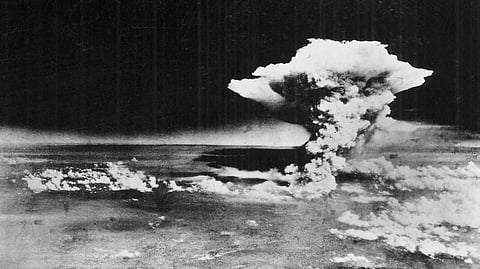

A previously unknown metal has been discovered in debris from the 1945 Hiroshima atomic bomb, offering new insight into the extreme conditions created during a nuclear explosion, according to a study published in Science Advances.
Researchers identified the material while analysing tiny fallout droplets, known as hiroshimaites, preserved in the sands of Hiroshima Bay, Phys.org reported. The droplets formed when temperatures exceeding 12,000°F vaporised buildings, soil, glass, metal and water during the blast.
Using electron microscopy and X-ray diffraction, the team examined 34 samples. Most contained ordinary iron-chromium alloys, but one microscopic grain revealed an unusual combination of iron, chromium, nickel, manganese, molybdenum, silicon and aluminium arranged in a crystal structure never before observed in conventional alloys.
The researchers said the alloy likely formed as metallic vapour from the explosion cooled almost instantly, trapping the atoms in a unique arrangement.
The findings suggest that extreme, human-made conditions can produce entirely new materials. Researchers believe the discovery could aid the development of lighter, more heat-resistant alloys and improve understanding of the chemical and physical fallout produced by nuclear explosions, New York Post reported.
On August 6, 1945, the US dropped the atomic bomb Little Boy on Hiroshima. The explosion, equivalent to about 20,000 tonnes of TNT, killed an estimated 140,000 people by the end of the year, while many survivors later developed radiation-related illnesses, including cancer and leukaemia.
