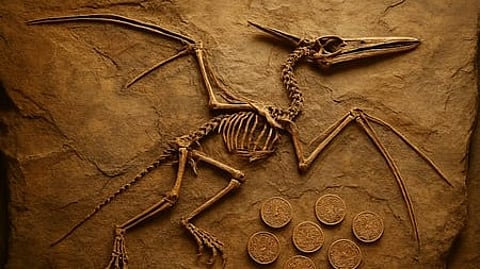

A dinosaur discovery rarely begins with a dinosaur. More often, it begins with palaeontologists walking for days through dry riverbeds and rocky slopes, searching for a bone fragment, tooth or unusual texture.
Unlike Hollywood’s dramatic excavations, a tiny surface fossil may be the only clue that something much larger lies buried beneath.
“Even a small bone fragment or isolated tooth on the surface can indicate that a much larger fossil lies buried beneath. Excavation itself requires remarkably simple equipment: geological hammers, chisels, brushes, needles, adhesives and protective plaster jackets used to stabilise fragile specimens before transportation,” Prof GVR Prasad, Professor at the Department of Geology in University of Delhi, told TNIE.
But the search begins much earlier. Palaeontologists study geological maps and research to identify rocks of the right age and environment, with ancient river and floodplain sediments more likely to preserve terrestrial dinosaurs.
“This explains why some parts of India have yielded abundant dinosaur fossils while others have produced very little. Large parts of the Himalayan region, for instance, are dominated by marine rocks from the same geological periods. Since these sediments formed beneath ancient seas rather than on land, they are unlikely to preserve the remains of terrestrial dinosaurs,” he said.
Marine deposits may preserve bones or footprints carried from land, but currents often scatter remains. Once excavated, fossils are protected and taken to laboratories, where years of preparation may precede identification, 3D modelling and publication in the scientific record.
Rebuilding animal from bone
But how do scientists reconstruct an animal nobody has ever seen alive? The bones themselves hold clues. Muscle attachment scars reveal where muscles once connected, while comparisons with birds and crocodiles, the closest living relatives of dinosaurs, help palaeontologists reconstruct posture, body shape and movement.
Limb bones can reveal an animal’s approximate height, length and weight, while 3D scanning allows fragile fossils to be studied and shared digitally. Skin colour and patterns remain largely uncertain unless rare fossils preserve soft tissues, but the skeleton provides a remarkably detailed blueprint.
When fossils refuse to fit the map
Sometimes, even a handful of fossils can challenge an entire evolutionary story.
“Fossils of prosauropods—early relatives of the giant long-necked sauropods—were once believed to have evolved primarily in South America before spreading elsewhere. Their discovery in India suggests that the evolutionary history of these animals may have been more complex than previously thought,” the geology professor added.
Then there are the teeth. Troodontid teeth identified in Tamil Nadu’s Cauvery Basin point to small dinosaurs closely related to modern birds, a group known mainly from North America, Europe and Asia.
Their presence in India raises two possibilities. They may have reached the Indian landmass as it drifted north after separating from Gondwana, or they may have been more widely distributed before Pangaea broke apart, with their fossils yet to be found elsewhere in the southern continents.
More discoveries from older rocks are needed to settle the question. And that uncertainty is precisely why every long walk across a dry riverbed matters.
India’s 165-million-year dinosaur story
India’s dinosaur record spans nearly 165 million years, with fossils scattered across geological basins. Its oldest dinosaur-bearing rocks date to the Triassic and Jurassic periods, while skeletons such as Barapasaurus and Kotasaurus have shed light on early long-necked dinosaurs.
“The story shifts dramatically during the Cretaceous Period, between about 145 million and 66 million years ago. Fossils from the Lameta Formation, stretching from Jabalpur in Madhya Pradesh to Balasinor in Gujarat, have yielded a remarkable diversity of dinosaurs, including giant herbivorous sauropods and several species of carnivorous theropods. Additional discoveries have been made in Maharashtra, while Tamil Nadu’s Cauvery Basin has produced fragmentary remains from younger terrestrial deposits overlying ancient marine rocks,” he said.
Jurassic fossils from Jaisalmer and Kutch, largely preserved in ancient marine deposits, are typically more scattered and fragmentary. Together, these sites map different chapters of prehistoric India.
India’s dinosaur fossils waiting to be noticed
Despite its rich fossil record, India still lacks adequate museums, public outreach and protection for many dinosaur sites. Several lie near remote villages where fossilised bones and eggs may not be recognised for their scientific value.
Researchers believe local fossil parks, regional museums and greater public awareness could help protect these sites. Scientists have also called for a dedicated national natural history museum to house and display India’s fossil heritage, though funding and infrastructure constraints have slowed progress.
Without stronger conservation, fossils risk being damaged, removed without documentation or lost. In palaeontology, context matters almost as much as the bone. Its location, surrounding rock and place within a geological layer are all part of its story.
And so, the search continues. Somewhere beneath India’s riverbeds and rocky slopes, another dinosaur story may still be buried. The only question is: who will spot the first bone?
