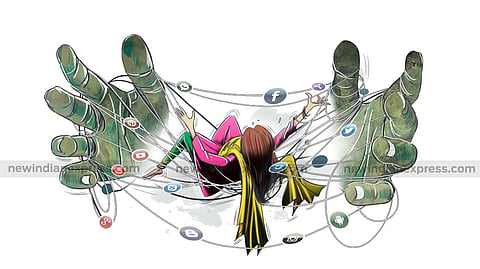

You click on a video questioning the 1969 Moon landing. The presenter points to odd shadows, a fluttering flag and grainy footage as “proof” that the mission was staged. You are sceptical but curious. The video ends and another begins. Soon, you are watching claims about Area 51, flat Earth theories or allegations that vaccines and climate science are part of hidden agendas.
Social media often receives the blame for these rabbit holes. But psychologists say the roots of conspiracy theories run much deeper than the internet.
“Conspiracy theories are certainly not new; people have long tried to explain major events by suspecting hidden groups working behind the scenes,” said Dr Daniel Jolley, professor of Social Psychology at the University of Nottingham.
Long before social media existed, people speculated about secret societies, hidden plots and powerful groups manipulating events from the shadows. Throughout history, conspiracy theories have emerged during wars, political upheavals, pandemics and periods of social change.
Researchers say part of the explanation lies in how people make sense of uncertainty.
Human beings are natural pattern-seekers. Faced with confusing or threatening situations, the brain looks for explanations that bring order and meaning. Conspiracy theories can be appealing because they turn complex events into simple narratives with clear causes, villains and motives.
Reality is often less satisfying. Scientific and historical explanations may involve multiple factors, incomplete information and a degree of uncertainty. Conspiracy theories, by contrast, can offer seemingly straightforward answers.
“Conspiracy theories can therefore provide a sense of understanding and certainty, even when the explanations themselves are inaccurate,” Jolley explains.
That appeal often becomes stronger during times of crisis.
“When people experience uncertainty, fear and a loss of control, they naturally begin searching for explanations,” Jolley said
Increasingly, researchers argue that conspiracy beliefs are not simply the result of misinformation. They are also linked to the way people respond to ambiguity, anxiety and uncertainty.
Studies suggest that people who dislike uncertainty, seek definitive answers or feel powerless may be more receptive to conspiratorial explanations. Intuitive thinking can sometimes outweigh careful scrutiny, particularly when claims are emotionally charged or appear to explain confusing events.
Psychologists have also identified the role of confirmation bias — the tendency to favour information that supports existing beliefs. Once people accept a particular explanation, they often pay more attention to evidence that reinforces it while discounting information that challenges it.
Repeated exposure can make the effect stronger. Familiar claims often feel more believable simply because they have been encountered many times before.
Other research has found links between conspiracy thinking and traits such as paranoia or a tendency to perceive hidden intentions in the actions of others. However, researchers caution that conspiracy beliefs are not confined to any single social group and can be found across education levels, professions and political backgrounds.
For Jolley, a more useful question is not who believes conspiracy theories but under what circumstances people become receptive to them. His research suggests that personal experiences matter. Workplace bullying, social exclusion and repeated feelings of powerlessness can influence how people interpret the behaviour and motives of others.
“Conspiracy beliefs do not emerge in a vacuum. People’s lived experiences matter,” he said.
Loneliness and isolation can also play a role. For some individuals, conspiracy communities provide not only explanations but also a sense of belonging.
“When people feel isolated or powerless, conspiracy theories can provide both an explanation and, in some cases, a sense of community,” Jolley explains.
That social dimension is often overlooked. Online conspiracy groups frequently function as communities where members share a common identity and see themselves as possessing knowledge that others have missed. In some cases, the community becomes as important as the belief itself.
Researchers are careful to distinguish between conspiracy theories and genuine conspiracies. History contains many examples of governments, corporations and organisations concealing information or engaging in wrongdoing. Political scandals, corporate cover-ups and intelligence operations have all involved secrecy and deception.
The difference, experts say, is that genuine conspiracies are ultimately supported by verifiable evidence. Conspiracy theories often persist despite the absence of such evidence and can become resistant to correction.
This is where social media enters the picture.
While psychology may create the conditions for conspiracy thinking, digital platforms can dramatically increase its reach.
“In the past, someone with a conspiracy belief might have struggled to find like-minded others. Today, online platforms can connect people across the world almost instantly,” Jolley said.
Modern platforms are built around engagement. Content that provokes strong emotional reactions often attracts more attention, generating further recommendations and visibility.
Researchers studying online behaviour have found that users who engage with a few pieces of conspiracy-related content are often shown more of the same. Over time, this can create information environments in which similar viewpoints dominate while opposing perspectives become less visible.
The result can be a reinforcing cycle. People seek information that supports their suspicions, algorithms supply more of it and repeated exposure gradually strengthens belief.
Once a conspiracy belief becomes part of a person’s worldview, correcting it can be difficult. Challenges to the belief may be interpreted not as evidence but as proof that powerful interests are attempting to suppress the truth.
This helps explain why fact-checking alone does not always change minds. Researchers increasingly point to media literacy, critical thinking and exposure to diverse viewpoints as more effective long-term responses.
Social media may accelerate the spread of conspiracy theories, but psychologists say the forces behind them are deeply human. In times of uncertainty, people search for explanations, patterns and meaning. Conspiracy theories offer all three, even when the evidence does not.
