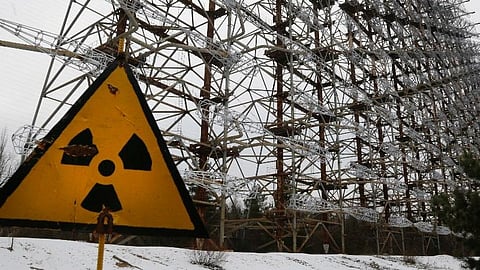

The blast is what people imagine. A sudden flash, a rising cloud, the moment when history splits into “before” and “after”. Nuclear disasters and atomic weapons are often pictured as events that happen in an instant. But the real story — of radiation — begins after the explosion ends.
Long after the shock waves fade, a quieter process continues inside matter. Deep within atoms, unstable nuclei keep transforming, releasing radiation slowly and invisibly for years, decades, or even millennia. This is why nuclear weapons, damaged reactors, and bombed enrichment facilities alarm the world. Radioactive materials do not vanish once released; they persist, gradually changing through a process called radioactive decay.
Some unstable atoms break apart within seconds. Others remain active for thousands or millions of years. Because of these vast differences in decay rates, nuclear contamination can persist long after conflicts end or accidents are contained.
At the heart of the process lies a delicate balance within the atomic nucleus. According to Dr P Hima Bindu, associate professor of physics at Osmania University, stability inside the nucleus depends on several internal forces working together.
“Radioactivity can be visualised like a corn kernel popping into popcorn. A nucleus remains stable for billions of years when forces such as the strong nuclear force, neutron–proton ratio, binding energy, and nuclear shell structure stay balanced. When this balance is disturbed, the nucleus becomes unstable and undergoes radioactive decay to reach a more stable state,” she explains.
Even when scientists understand these conditions, the exact moment of decay cannot be predicted. Because radioactive decay is a quantum tunnelling event, scientists can only calculate the probability of when it might occur.
To track this behaviour, researchers use half-life, the time required for half the atoms in a sample to decay. If the energy barrier inside the nucleus is thin, particles escape easily and the half-life is short. If the barrier is thick and the nucleus closer to stability, decay becomes much slower and the half-life longer.
When decay occurs, the nucleus releases radiation in different forms: alpha particles, beta particles, or gamma rays, each carrying energy away from the atom.
These radiations behave very differently in the environment. Dr Boorugu Sreenivas, Assistant Professor of Physics at SRBGNR Government Degree College in Khammam, explains that each type travels different distances and requires different shielding.
“During radioactive decay, the nucleus emits particles or radiation in the form of alpha, beta, or gamma rays. In most cases this changes the atom’s mass number and atomic number, producing a new and often more stable nucleus, while gamma emission releases energy without altering these numbers,” he explains.
Radioactive decay also changes elements themselves. Dr Mavurapu Satyanarayana, Assistant Professor at Telangana University, explains that when a nucleus emits radiation its atomic structure shifts. “In the process of radioactive decay, the nucleus/excited nucleus emits particles/radiation in the form of alpha and beta/gamma-rays. In general, a change in its atomic and mass number is observed (no change in the case of gamma ray emission), forming a stable new nucleus,” he says.
Heavier elements are more unstable because their nuclei contain many protons that strongly repel each other. Over time, repeated emissions gradually transform these atoms into more stable forms.
Despite its risks, radioactive decay is widely used, for instance, in medical imaging with isotopes such as fluorine-18 and iodine-131. Yet the same process also causes contamination to persist, as radiation declines only over decades.
